



MU vs Aston Villa: 'Red Devils' Revealing Critical Weakness



After a fairly impressive start under Michael Carrick, MU is beginning to reveal a concerning issue in their gameplay: a lack of width in their attacking organization.
When the options for developing play out to the two flanks are no longer maintained consistently, MU's approach becomes more predictable, allowing opponents to defend tightly in the central areas and significantly limiting the 'Red Devils' ability to create breakthroughs.
The Achilles' Heel on the Left Flank
Victories over Man City and Arsenal previously showed an energetic MU, pressing aggressively and transitioning quickly to attack. But when entering matches against West Ham, Everton, and Crystal Palace, that sharpness gradually disappeared.
The peak of their stagnation appeared during the away trip to Newcastle. Despite the opponent having only 10 men in the second half, MU still lost 1-2 in a match where their attacks were too monotonous and lacked surprise.
The absence of Patrick Dorgu and Lisandro Martinez has significantly disrupted the ability to build play on the left flank, an area that was once the main attacking direction in the early part of the season.
When these two players are missing, MU is forced to use alternatives like Leny Yoro and Matheus Cunha. However, their style of play differs significantly from the original structure.
Yoro, only 20 years old, is still in the process of refining his skills in initiating attacks from the defensive line. He isn't truly confident with breakthrough line-breaking passes, which previously helped MU move the ball quickly from their own half to the midfield area.
Meanwhile, Cunha is most dangerous when moving into the left 'half-space' (the tactical area running vertically between the center and the wing channel) to find gaps in the central zone. The tendency of the Brazilian forward to drift inside sometimes leaves MU's left flank lacking a wide player, significantly reducing the width in attacking phases.
Statistics show that in the match against Palace, MU's proportion of attacks on the left flank was the lowest since the start of the 2025-26 season. When Shaw also had to leave early due to fitness issues, the team's ball development structure became even more unbalanced.
In the first three matches under Carrick, MU often used several left-footed players in the attacking area like Dorgu, Bryan Mbeumo, and Amad Diallo. They were supported from behind by Shaw and Martinez, helping the team maintain reasonable width.
But in the match against Palace, by the end of the first half, Mbeumo was the only left-footed player remaining on the pitch. This made MU's ball development phases more monotonous and predictable.
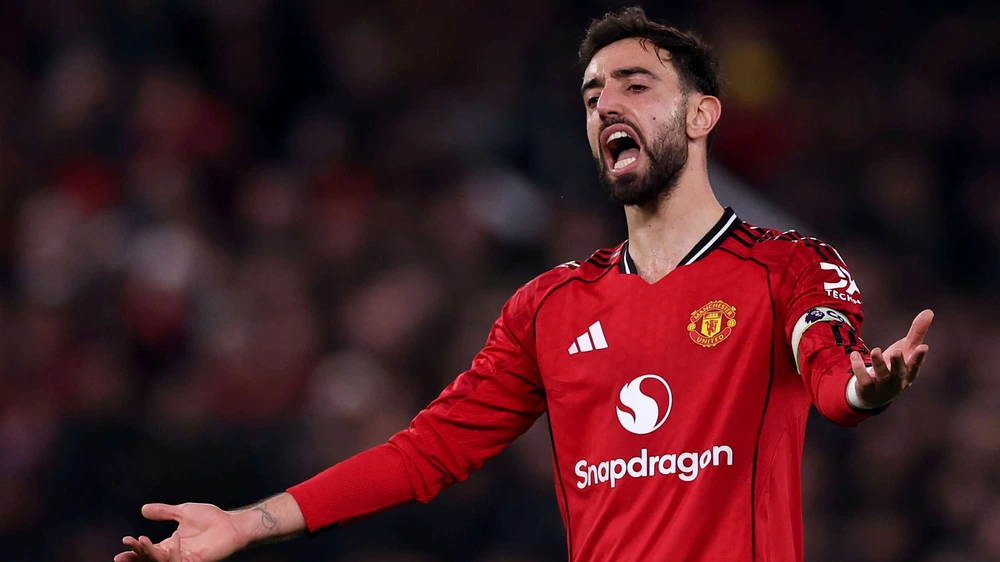
MU's attack has been very monotonous in recent matches
How will Carrick solve it?
In the match against Newcastle, Cunha tried to play more like a traditional winger. He often received the ball in deep and wide positions to directly face right-back Kieran Trippier.
Cunha was the most active player in MU's attack with 68 touches, far surpassing Sesko and Mbeumo. Thanks to this, MU's attacking direction was somewhat redistributed between the two wings.
However, Cunha's individual effort was still insufficient to change the overall situation. Many long passes were directed towards him, but the Brazilian forward often found himself isolated. When Cunha successfully contested the ball, no teammate was close enough to capitalize on the second ball.
Midfielders like Kobbie Mainoo or Shaw also haven't been able to create a clear impact in supporting this area. That makes the long-ball plays less effective.
To solve the current problem, Carrick can hope for the return of Dorgu and Martinez. Their presence will help MU improve ball circulation on the left flank.
Additionally, the 10-day break before the match against Aston Villa also provides an opportunity for Carrick and the coaching staff to adjust tactics. If they continue using direct passes aimed at Cunha, players like Mainoo or Shaw need to move closer to contest the second ball.
Another option is to utilize Amad's dribbling ability more. Despite inconsistent form since returning from the Africa Cup, the 23-year-old remains one of the team's best dribblers.
In modern football, a team struggles to maintain attacking momentum without width in their play. When unable to stretch the opponent's formation, all attacking routes are forced into the central area, where defenses are always most crowded. MU is currently falling into precisely that situation.


Wonderfulshortvideo
🇪🇸 Spain 🆚 Argentina 🇦🇷


Arsenal goal today arsenal 2-1 chelsea arteta interview arteta press conference
When Diogo Costa saved EVERY penalty he faced in the shoot-out 🤯🤯🤯
The movement is electric ⚡️
Mbappe injury mbappe surgery real madrid 0-1 getafe mbappe return date mbappe edit
ronaldo almeria ronaldo buying new club ronaldo owner ronaldo manchester united owner
de bruyne edit de bruyne passing kdb edit kdb passing highlights rodrygo kevin de bruyne neymar kevin de bruyne
 Links
Links
 Contact
Address:UNIT 1804 SOUTH BANK TOWER, 55 UPPER GROUND,LONDON ENGLAND SE1 9E
Number:+85259695367
E-mali:[email protected]
 App
App


