



Chelsea suffers a devastating 2-8 defeat against PSG: Gloom looms everywhere.



Within just one week, Chelsea experienced a series of consecutive setbacks so severe that even the most pessimistic individuals could hardly imagine.
For manager Liam Rosenior, this is not merely a difficult period, but rather a harsh "survival test" right in his first months at Stamford Bridge.
When everything collapses simultaneously.
The peak of this nightmare was the 0-3 home defeat to PSG, which halted Chelsea's progress in the UEFA Champions League Round of 16 with an aggregate score of 2-8, one of the club's heaviest losses in continental competition history.
But the concern lies not only in the numbers, but in how Chelsea collapsed. The team almost completely lost its identity, played disjointedly, lacked cohesion, and was easily stifled by the opponent. Reactions from the stands also clearly reflected this situation: boos echoed, Rosenior's substitution decisions were protested, and even more disheartening was the wave of fans leaving before the match ended.
In this context, ambiguous statements about Enzo Fernandez's future further darkened the atmosphere. As the captain against PSG and expected to be a long-term pillar, the Argentine midfielder's apparent wavering is nothing less than a warning signal. When a leader is uncertain about his future, maintaining stability in the dressing room becomes an extremely difficult task.
Simultaneously, a series of incidents followed like a domino effect. The decision to use Filip Jorgensen instead of Robert Sanchez in the first leg backfired, contributing to Chelsea losing their advantage. Pedro Neto further worsened the situation with an additional suspension due to his earlier uncontrolled behavior.
The 0-1 defeat to Newcastle in the Premier League further eroded confidence. These problems did not exist separately, but piled up, forming a negative spiral. Chelsea not only lost matches, but also lost its image, self-confidence, and the faith of its supporters.
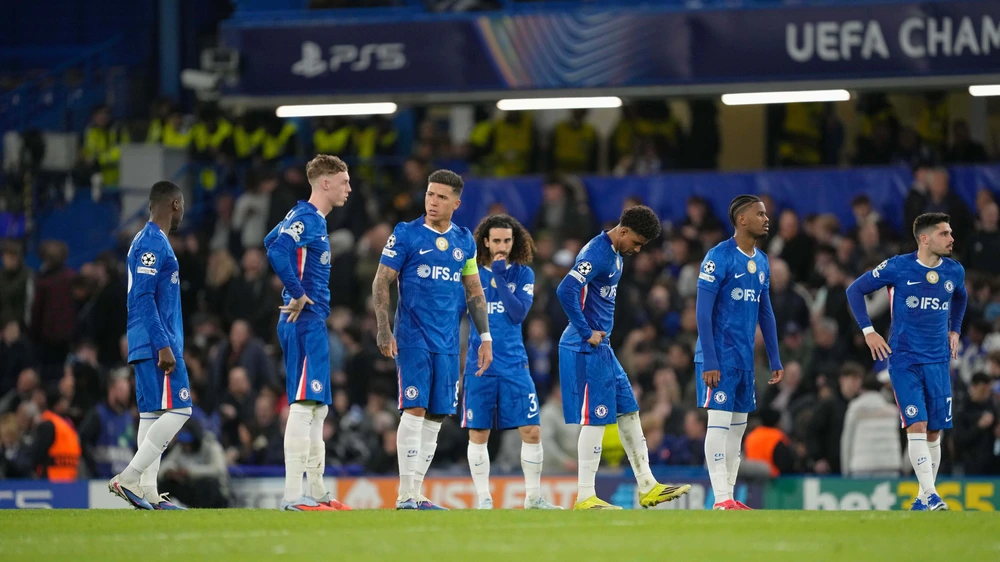
Chelsea just endured the most forgettable week of the season.
Pressure surrounds Rosenior.
Chelsea's crisis extends beyond the pitch, reaching the higher levels. Before the second leg against PSG, the club received a penalty from the Premier League organizers related to financial violations from the Roman Abramovich era. Besides a hefty fine, the team also faces transfer restrictions.
At the same time, an incident involving the academy led to Chelsea being restricted from recruiting young players for months. These consecutive legal issues worsened the club's image and added pressure on the leadership and coaching staff.
On the field, the injury list grew longer. Reece James suffered a hamstring injury and faces a long-term absence. Malo Gusto was unavailable due to health reasons, and Trevoh Chalobah left the pitch on a stretcher during the PSG match. These losses made Chelsea's already unstable lineup even more fragile. Furthermore, the recurring issue of lineup leaks before matches continued, indicating serious internal vulnerabilities. When trust within the team erodes, building a united collective becomes nearly impossible.
In this context, Rosenior became the focal point of all scrutiny. After two months in charge, his "honeymoon period" is over. What remains is pressure, skepticism, and the demand to steer the team back on track immediately.
Nevertheless, Rosenior maintains a calm demeanor. He reaffirms faith in his methods and emphasizes that football always has unexpected turns. However, reality shows that what he needs now is not just faith, but concrete solutions to restore stability.
In domestic competition, Chelsea still has a chance to salvage the season as they compete for a Top 5 position. However, the precarious point gap also means any slip-up could cost them dearly.
After spending over two years to return to the Champions League, Chelsea certainly does not want to repeat the old vicious cycle. If they cannot secure European qualification next season, the entire rebuilding process over recent years risks collapsing.


Wonderfulshortvideo
Kvaratskhelia and Ronaldo 🫶


🇪🇸 Spain 🆚 Argentina 🇦🇷
Arsenal goal today arsenal 2-1 chelsea arteta interview arteta press conference
When Diogo Costa saved EVERY penalty he faced in the shoot-out 🤯🤯🤯
The movement is electric ⚡️
Mbappe injury mbappe surgery real madrid 0-1 getafe mbappe return date mbappe edit
ronaldo almeria ronaldo buying new club ronaldo owner ronaldo manchester united owner
 Links
Links
 Contact
Address:UNIT 1804 SOUTH BANK TOWER, 55 UPPER GROUND,LONDON ENGLAND SE1 9E
Number:+85259695367
E-mali:[email protected]
 App
App


