



Enthralled by Hansi Flick's Barcelona



The Champions League stage recently witnessed one of the most beautiful matches of the season, as Barcelona defeated Newcastle 7-2 in the second leg of the round of 16 (aggregate 8-3).
Barcelona, under the brilliant guidance of Raphinha and the inspired Lamine Yamal, captivated everyone with the attacking philosophy Hansi Flick has built over nearly two years.
Europe shaken by Barcelona
The 7-2 victory over Newcastle in the Champions League round of 16 second leg was not merely a scoreline demolition by Barcelona, but also served as a tactical manifesto under Hansi Flick, coinciding with Joan Laporta's return to the presidency. This match clearly showcased every core element of Flick's philosophy: intensity, boldness, organization amidst chaos, and above all, absolute faith in their style of play.
The first half at Camp Nou unfolded like a boxing match with no intervals. Barcelona led, Newcastle equalized, then Barcelona led again and was pulled back to parity. The 3-2 scoreline after the initial 45 minutes accurately reflected the nature of a direct, confrontational match—a continuous exchange of blows where both teams accepted risks to seek goals. In that context, one might question whether Flick's approach was overly risky.
The answer lay in the second half. When Barcelona emerged after the break, they did not alter their philosophy, only adjusting its execution. Pressing was maintained at high intensity, the defensive line still pushed up near midfield, but everything became more precise and synchronized. Newcastle no longer found the gaps they had earlier, while Barcelona began exploiting every transition opportunity thoroughly. The result was four more goals—three of them within just 10 minutes, starting from the 61st minute.
In that system, Lamine Yamal and Raphinha were two standout highlights, but how they shone further reflected Flick's philosophy most clearly. Lamine embodies freedom within a framework. He moves flexibly, can drop deep to receive the ball, cut inside centrally, or drift wide, always giving the sense that a single moment could shift the match's complexion. Notably, Yamal's actions do not disrupt the overall structure; they exist within it. He is granted freedom, but it is controlled freedom—a detail showing Flick does not suppress individuality but positions it optimally to maximize its impact.
Meanwhile, Raphinha represents the "discipline" aspect of the system. He initiates pressing, links transitions, and directly finishes when opportunities arise. The opening goal, winning a penalty, assisting Fermin's goal, helping Lewandowski "explode" back into form, sealing the result, and numerous involvements in attacking sequences showcase a comprehensive Raphinha, but more importantly, a Raphinha operating perfectly within Flick's system.
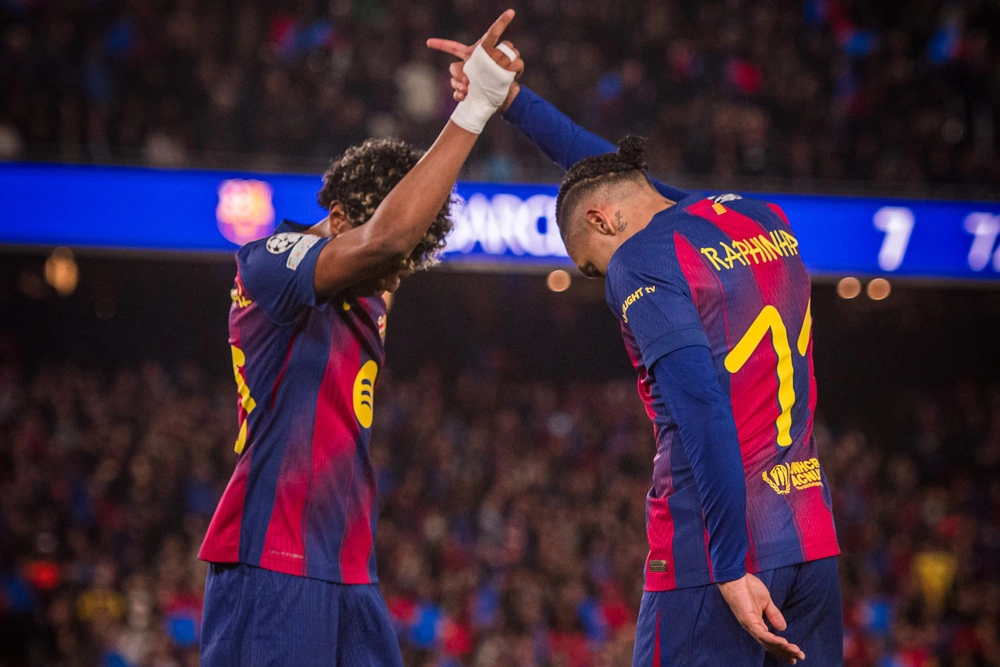
Barcelona delivers an impressive attacking performance
Flick's Philosophy
The combination of these two elements—creative freedom and tactical discipline—creates a Barcelona that is both explosive and organized. This is not easy to achieve, especially for a team still rebuilding. This also marks the biggest difference compared to previous eras under Ronald Koeman or Xavi: Barcelona not only plays beautifully but also has solid structure.
Flick's philosophy, ultimately, is not a new invention. High pressing, a high defensive line, rapid transitions—all have appeared in modern football. But his application at Barcelona carries a distinct nuance. It combines German-style discipline with the attacking spirit inherent in the Catalan club's DNA.
This explains why Barcelona could score seven goals against a formidable opponent like Newcastle. For the first time in the post-Lionel Messi era, Barcelona concluded a Champions League match with seven goals. "Blaugrana" does not wait for mistakes; they proactively force opponents into errors. They do not slow down after leading; they continue increasing pressure. Most importantly, Barcelona maintained faith in their style even when the match became chaotic in the first half. A philosophy that Yamal and the 2007-born player group are enthralled by.
It can be said this victory stems not merely from Yamal or Raphinha's individual form, but from a system functioning correctly. When every component operates synchronously, Barcelona becomes an almost unstoppable attacking machine.
In a certain sense, Flick's football delivers intense emotion, even a somewhat "addictive" feeling—the sensation Barcelona fans were once familiar with in the past. But the difference this time is that this emotion is not born from mere spontaneity; it is built upon a clear tactical foundation. Barcelona no longer struggles to find its identity; it has begun redefining itself. If they can sustain the balance between emotion and structure as in this match, the dream of conquering Europe has solid grounds (first, they must settle the debt with Atletico in the quarter-finals). And of course, defending the La Liga title as well.


Wonderfulshortvideo
Kvaratskhelia and Ronaldo 🫶


🇪🇸 Spain 🆚 Argentina 🇦🇷
Arsenal goal today arsenal 2-1 chelsea arteta interview arteta press conference
When Diogo Costa saved EVERY penalty he faced in the shoot-out 🤯🤯🤯
The movement is electric ⚡️
Mbappe injury mbappe surgery real madrid 0-1 getafe mbappe return date mbappe edit
ronaldo almeria ronaldo buying new club ronaldo owner ronaldo manchester united owner
 Links
Links
 Contact
Address:UNIT 1804 SOUTH BANK TOWER, 55 UPPER GROUND,LONDON ENGLAND SE1 9E
Number:+85259695367
E-mali:[email protected]
 App
App


