



Tottenham and the costly lesson from the past



Nearly 50 years ago, Tottenham dropped out of England's top division at that time (First Division). The lesson from that season remains fully relevant to Tottenham today.
Tottenham was the first English club in the 20th century to win the double of the league championship and FA Cup in 1961, and also the first to claim a European trophy by winning the Cup Winners' Cup two years later. They were renowned for their attractive style of play and the goal-scoring prowess of legend Jimmy Greaves.
The season that hit rock bottom led Tottenham to relegation
Under manager Bill Nicholson, they added two League Cups and a UEFA Cup in the early 1970s. Despite their past glorious successes, Tottenham had to face relegation by finishing bottom of the table in the 1976/77 season.
On May 7, 1977, Tottenham suffered a crushing 5-0 defeat to Man City at Maine Road and were officially relegated. What happened to lead to that disastrous moment? How could one of England's biggest clubs fall from the top flight? And could the lessons from Tottenham's most unbelievable relegation help the current team, which is caught in a survival battle as Igor Tudor fails to halt the decline?
"Tottenham, sadly hitting the bottom" was the headline in the Sunday Mirror the day after the club's relegation. Pat Jennings, Tottenham's goalkeeper, considered the world's best at that time, told reporters: "Relegation didn't just happen today, it has been happening over the last three years."
He was referring to manager Bill Nicholson resigning after losing the first four games of the 1974/75 season, ending his 16-year reign and creating "a shock that spread through the dressing room." In fact, the Tottenham empire had begun to crumble in earlier seasons, mainly due to the inability to replace key pillars. In the mid-1960s, captain Danny Blanchflower retired, forward John White died after being struck by lightning on a golf course, and winger Terry Medwin's career ended due to a broken leg; the elements of the historic double-winning squad gradually disintegrated.
Manager Terry Neill, who had played as a center-back for Arsenal for a decade, succeeded Nicholson and led the team to finish 19th in 1974/75. After lifting Tottenham to 9th place, Neill unexpectedly left in the summer of 1976 to take charge of Arsenal. His successor was manager Keith Burkinshaw, entrusted with leading a squad weakened by the departure of several key players, including Martin Chivers.
They lost their first two matches and performed inconsistently in the 1976/77 season. In mid-October 1976, Tottenham traveled to Derby's ground and were hammered 8-2. Continuous defeats created a gloomy atmosphere within the team, with many arguments erupting. Midfielder Glenn Hoddle revealed that defenders blamed the forwards and vice versa. Peter Taylor, a winger, said: "We conceded 72 goals that season. I think we had ten times more creative players than now, but we let in too many goals."
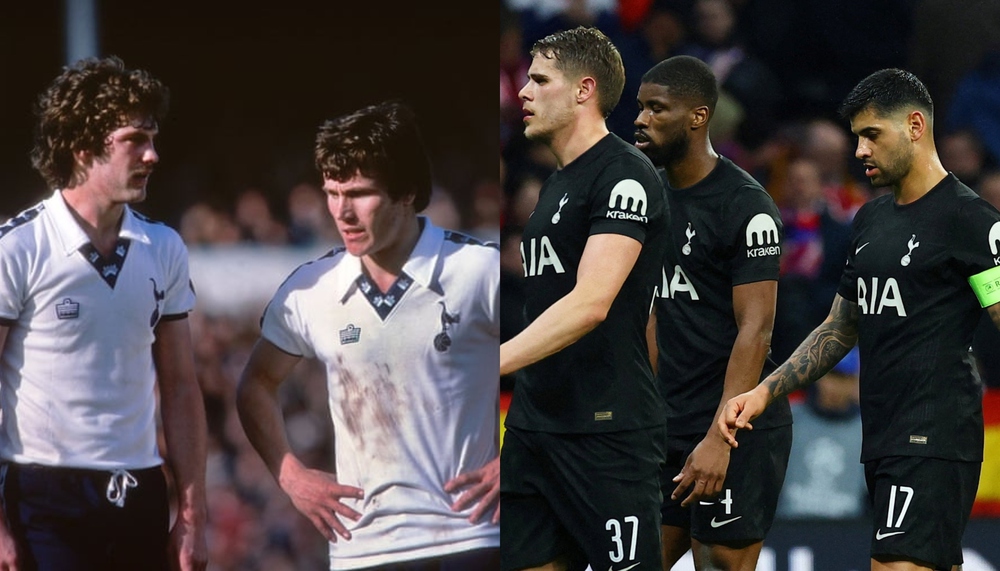
Tottenham is now in a situation similar to their own in the 1976/77 season
A lesson for the current season
Even at their home ground White Hart Lane, the already disheartened fans quickly turned against the team. "The home games were really tough," Hoddle shared. "The crowd put pressure on the whole team, and things got worse when a misplaced pass was met with jeers."
Tottenham ended the 1976/77 season with 33 points, in a context where a win was worth only 2 points. Statistically, Tottenham won 12, drew 9, and lost 21 matches that season. When Taylor reviewed the First Division standings for 1976/77 on an iPad, he still couldn't "believe we only got that many points."
Tottenham then spent one season in Division 2 before returning to the top flight. Now, the club again faces relegation danger as manager Igor Tudor's team sits 16th with 30 points after 30 matches, just one point above the bottom group.
Regarding Tottenham's current situation, Taylor, who experienced relegation with the club back then, asserted: "They need to recognize that some issues, like transfer dealings, haven't been handled properly, and that's why they are in this predicament."
Taylor also pointed out that Tottenham this season lacks creativity and unpredictability. Additionally, Taylor believes Tottenham's major mistake was sacking manager Thomas Frank.
"Personally, I wouldn't have replaced Thomas Frank. He understands the Premier League and proved that while at Brentford. Unfortunately, too many people had a negative attitude toward him. They didn't support him but wanted him out, but personally I wouldn't have changed," Taylor stated.
He emphasized that Tottenham needs collective spirit more than attractive play, and captain Cristian Romero must demonstrate leadership if he wants to help the team survive.
"I would accept playing awful football in the last nine games, provided we get three or four wins. That's what they need, and a united dressing room will achieve that," Taylor affirmed. "I'm still hoping Tottenham can win a few more matches and stay up. But if not, this fall will be a painful lesson that wakes them up."
In the 1976/77 season, Tottenham were relegated by just two points from safety. Their biggest problem was defense, conceding 72 goals (the most in the league), with a goal difference of -24. Tottenham had positive moments like beating Manchester United, Leeds, and Liverpool. However, they suffered from severe inconsistency. In their last five matches, Tottenham won two, lost two, and drew one.
Besides poor form in the First Division, Tottenham were also eliminated from the FA Cup by Cardiff in the third round and from the League Cup by Wrexham in the fourth round. It was a regrettable season for Tottenham, as they still had a squad with quality figures like Pat Jennings, Peter Taylor, Steve Perryman, and Glenn Hoddle.


Wonderfulshortvideo
Kvaratskhelia and Ronaldo 🫶


🇪🇸 Spain 🆚 Argentina 🇦🇷
Arsenal goal today arsenal 2-1 chelsea arteta interview arteta press conference
When Diogo Costa saved EVERY penalty he faced in the shoot-out 🤯🤯🤯
The movement is electric ⚡️
Mbappe injury mbappe surgery real madrid 0-1 getafe mbappe return date mbappe edit
ronaldo almeria ronaldo buying new club ronaldo owner ronaldo manchester united owner
 Links
Links
 Contact
Address:UNIT 1804 SOUTH BANK TOWER, 55 UPPER GROUND,LONDON ENGLAND SE1 9E
Number:+85259695367
E-mali:[email protected]
 App
App


