



Domestic players and the 'challenge' of elevating V-League



V-League is a fiercely competitive environment where young and domestic players must cultivate resilience to avoid being overshadowed by high-quality foreign players.
For many years, the challenge of acquiring skilled forwards has been a persistent concern for Vietnamese football. It is not that we lack attacking players, but rather that we rarely have "strikers" sharp enough to decisively influence matches. From club level to the national team, the question of "who will score" often remains a significant issue, especially in crucial moments.
The influx of high-quality foreign players into V-League and the demand for squad upgrades by clubs create intense competition for starting positions among domestic players. With superior physique, speed, and finishing ability, foreign forwards almost completely secure the trust of coaches. This inadvertently limits opportunities for domestic forwards to play, leading to inconsistent performance and hindered development. Although V-League has repeatedly adjusted regulations on foreign player quotas, the reality shows that opportunities for domestic forwards remain very narrow.
To survive and establish their position, Vietnamese players must strive to overcome difficulties, reinvent themselves, and seize every opportunity given to showcase their abilities. Looking at the current landscape, the number of domestic forwards who have made a distinct impact remains very few. Names like Nguyễn Tiến Linh, Phạm Tuấn Hải, Nguyễn Đình Bắc need to maintain long-term consistency. Even Tiến Linh, once the winner of the Vietnam Golden Ball, is experiencing a difficult phase, resulting in losing his spot on the national team. This is not just a story of individual performance but also reflects the harshness of competition at present.
In this context, the use of naturalized players in the attack has emerged as a new solution. And in practice, the success of Nguyễn Xuân Son has proven this is not merely an experimental choice. His consistent scoring ability, robust physical condition, and competitive composure have brought a fresh dynamic to the national team's attack.
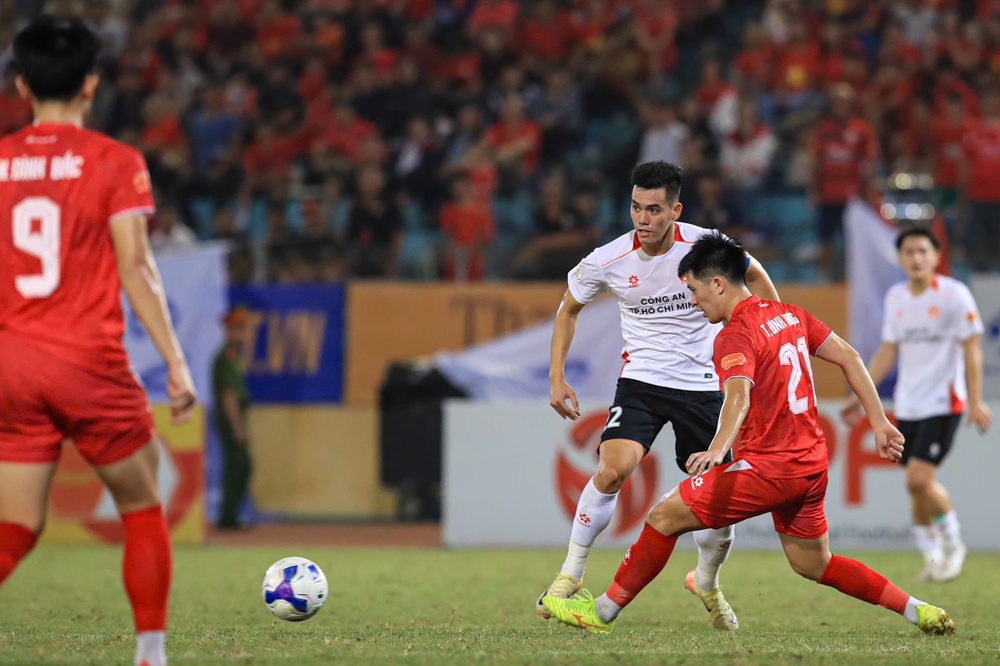
Tiến Linh (in white shirt) lost his position on the Vietnam national team due to failing to maintain regular scoring ability at his club. Photo: Hoàng Linh
However, the emergence of naturalized forwards poses a greater challenge for domestic strikers. If previously, a position on the national team was almost a "familiar destination" for certain names, now, no spot is guaranteed. Competition now comes not only from domestic peers but also from players with more diverse physical foundations and playing experience.
Nevertheless, viewed positively, this is a necessary impetus. Professional football has no room for complacency or privilege. Domestic forwards must refine themselves. The issue is not about having or not having naturalized players, but about how Vietnamese forwards respond to competitive pressure. It can be said that foreign players are not the sole reason domestic players struggle to develop; they can also be a catalyst if utilized correctly.
To affirm their position, domestic strikers have no other choice but to reflect on themselves. They need to improve consistency, enhance scoring efficiency, and most importantly, maintain the desire to advance. Only when ready to compete fairly can they regain the trust of coaches and fans.
If V-League merely limits the number of foreign players, it only addresses the surface issue. What is needed more is a long-term strategy for training quality young players to expand the player export market. Even if the league adds more foreign players, Vietnamese players can still have parallel development paths. Only by balancing these two factors can Vietnamese football both have an attractive, competitive V-League and a strong, sustainable national team.


Wonderfulshortvideo
Kvaratskhelia and Ronaldo 🫶


🇪🇸 Spain 🆚 Argentina 🇦🇷
Arsenal goal today arsenal 2-1 chelsea arteta interview arteta press conference
When Diogo Costa saved EVERY penalty he faced in the shoot-out 🤯🤯🤯
The movement is electric ⚡️
Mbappe injury mbappe surgery real madrid 0-1 getafe mbappe return date mbappe edit
ronaldo almeria ronaldo buying new club ronaldo owner ronaldo manchester united owner
 Links
Links
 Contact
Address:UNIT 1804 SOUTH BANK TOWER, 55 UPPER GROUND,LONDON ENGLAND SE1 9E
Number:+85259695367
E-mali:[email protected]
 App
App


