



Monday Coffee: When Arteta Had to 'Betray' Wenger



One of the reasons Mikel Arteta was eager to join Arsenal in the past was his admiration for the legendary manager Arsene Wenger's philosophy of beautiful football.
1. "That (Arsenal's style of play) was captivating, and I think every player wanted to play here" - Arteta emphasized. "I dreamed of playing for this club, because of how Arsenal played under Mr. Wenger."
"His passion for the game was truly distinct and you could recognize it immediately" - Arteta couldn't hide his respect. "He genuinely respected the game and wanted to play in a unique style."
To put it plainly, Arteta's dream was likely to become a manager like Wenger, someone who absolutely believed in football and beauty. Someone who always thought the value of football should lie in nurturing and respecting talent, not just throwing money out the window.
If life were a movie, this would be a common motif for the ending: Arteta steadfastly follows the path chosen by his great mentor, and despite obstacles, inherits his will and succeeds.
2. But because life isn't a movie, it unfolded in a direction even rather unfortunate for those who admired Arsene Wenger: The person who most admired Wenger's philosophy ended up doing completely... the opposite, and is even heading toward a hugely successful season for Arsenal.
"From his second season, Arteta shifted from Pep Guardiola's style entirely to Mourinho's style" - Jamie Carragher commented bluntly on Sky Sports. "The new signings all show physical strength and tackling ability. I've never seen such a drastic change."
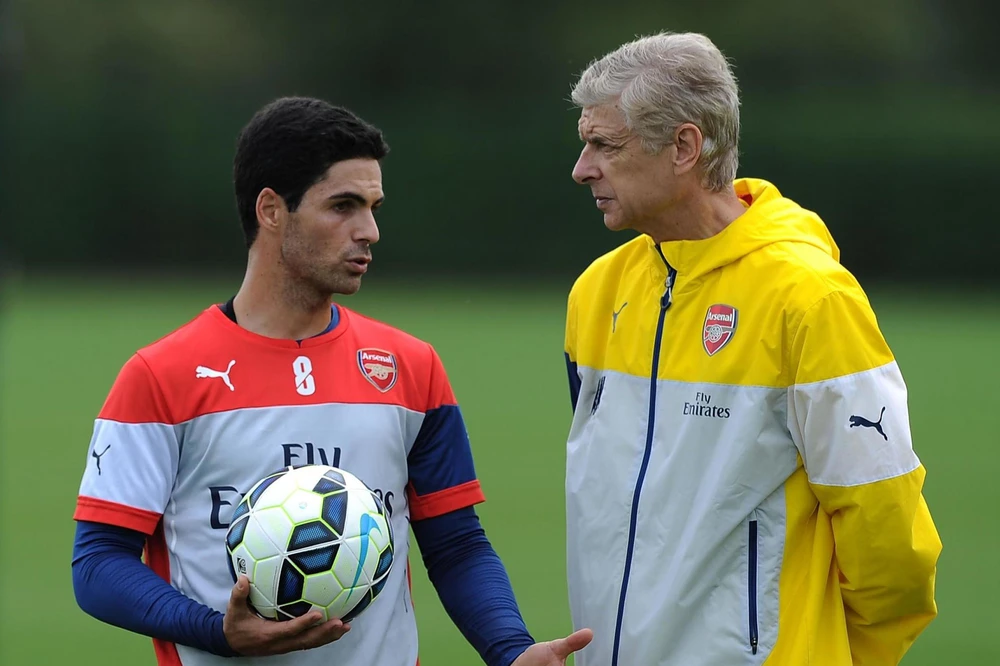
Arteta (left) had to sacrifice what he truly loved in football
Under Arteta, Arsenal practiced more than anyone to turn every set-piece into a tangible, graspable opportunity. Under Arteta, Arsenal could also drop deep and play extreme defense in situations needing to protect a score.
Not merely pragmatic, sometimes Arteta reached an extreme level of play: "It seems Arteta would never risk overly ambitious goals and trade everything. Arsenal got here through pragmatism, and Arteta likes applying data on player minutes and recovery capacity" - noted Barney Ronay, a prominent commentator for The Guardian. Football365 even called the tactics Arteta employs "medieval."
Last summer, Arsenal underwent the most expensive transfer window in its history, in a full-fledged effort to chase a trophy after years without one. That acted like a strong denial of Manager Wenger's philosophy, who always believed today's transfer market was overly "inflated," paying far beyond a player's value.
3. When Arsene Wenger first arrived at Arsenal over three decades ago, British headlines read: "Arsene Who?" Captain Tony Adams later admitted the initial impression of Wenger was very negative: "We thought, what does this French guy know about football?" Players even sang mocking songs about Manager Wenger on the bus due to his ban on chocolate.
But despite being unknown and facing resistance from the start, football back then still had space for a manager allowed to think about his philosophy, rather than having to win immediately and always. "If any player still doubted Wenger, they were the ones who had to pack up" - Vice Chairman David Dein stated firmly after people doubted the French manager. The club's major shareholders were angry about Rioch's dismissal, but didn't demand Wenger deliver results instantly.
Perhaps that atmosphere nurtured the French manager's determination to pursue beautiful football. There were doubts and mockery, but no pressure to win.
What about football now? The pressure to win has grown so immense that even strong teams often become tense and "self-destruct" more frequently. Arsenal was famously prone to "self-destruct" before, but this season, Man City and Liverpool have been more tense and made more mistakes than Arteta's side, even though these teams have dominated the Premier League for a decade.
Arteta having to sacrifice what he truly loved in football to pursue the championship isn't a matter of right or wrong. It only speaks to an undeniable reality of modern football: The demand for results has gone too far and too fast, so a manager won't have the chance to ask themselves what kind of leader they truly want to be, and how the team should play.
An era that doesn't allow leaders the right to believe in what they love is more sad for the era than for the person who had to betray what they loved.


Wonderfulshortvideo
Kvaratskhelia and Ronaldo 🫶


🇪🇸 Spain 🆚 Argentina 🇦🇷
Arsenal goal today arsenal 2-1 chelsea arteta interview arteta press conference
When Diogo Costa saved EVERY penalty he faced in the shoot-out 🤯🤯🤯
The movement is electric ⚡️
Mbappe injury mbappe surgery real madrid 0-1 getafe mbappe return date mbappe edit
ronaldo almeria ronaldo buying new club ronaldo owner ronaldo manchester united owner
 Links
Links
 Contact
Address:UNIT 1804 SOUTH BANK TOWER, 55 UPPER GROUND,LONDON ENGLAND SE1 9E
Number:+85259695367
E-mali:[email protected]
 App
App


