



At Real Madrid, will Arbeloa be like Zidane or Solskjaer?



When President Florentino Perez decided to appoint Alvaro Arbeloa to replace Xabi Alonso mid-season, he knew this former defender could achieve something even better.
Sometimes, this president's decisions rely more on intuition than experience. For instance, he replaced Benitez with Zidane, an assistant of Ancelotti, and achieved great success.
Arbeloa's Change
Arbeloa leans more toward experience because Perez has monitored the work of this 43-year-old coach for some time, and after the revolution with Xabi Alonso failed, he acted swiftly hoping to fix problems and bring a new vision.
There will certainly be doubts, and that happened after Galaxy faced a series of failures: elimination from Copa del Rey by Albacete, two consecutive defeats in La Liga, and being crushed by Jose Mourinho's Benfica in the Champions League.
But things turned around after a hard-fought win against Celta Vigo; the team returned with an energetic image and collective cohesion. Arbeloa taught Pep Guardiola a football lesson, followed by "educating" Diego Simeone last weekend.
Of course, problems won't easily disappear just after victories. Ancelotti did similarly before leaving empty-handed. If a world football legend couldn't make things smoother, how could a Castilla coach with little experience successfully salvage a sinking ship?
But positive signals emerged offering hope. In a short time, Arbeloa achieved what Alonso couldn't: awakening the talent of stars like Vini or Valverde.
Another major positive point helping Arbeloa gain trust is his belief in the youth academy. The 43-year-old coach faced many injuries but didn't complain; instead, he returned to Castilla's values, treating young players as seasoned veterans with keys in hand.
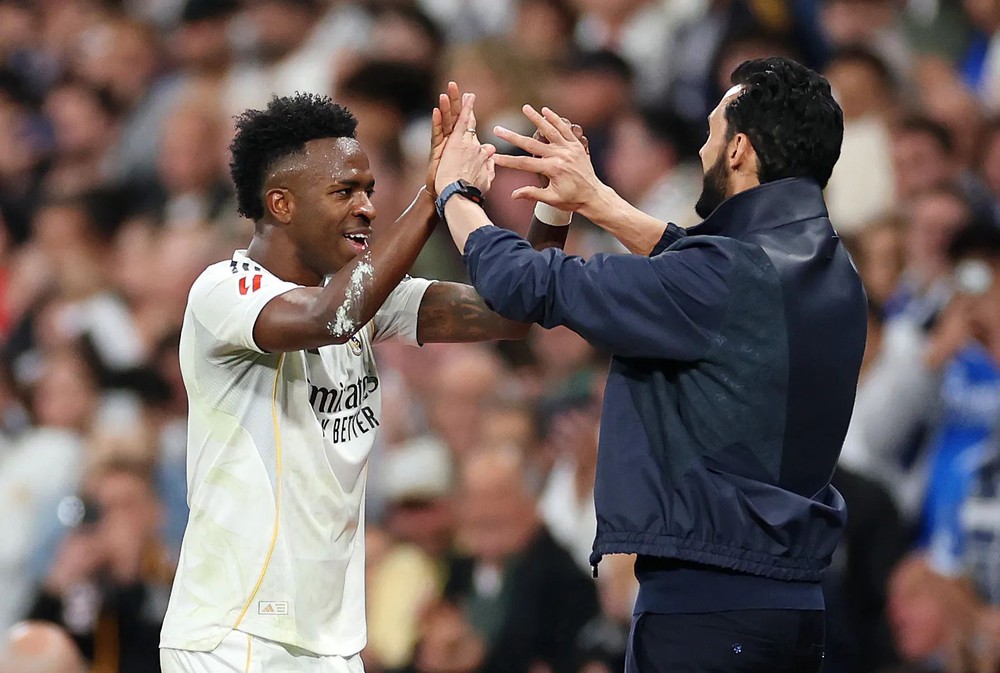
Arbeloa is gradually finding his rhythm at Bernabeu
While showing ability to persuade stars and strong personality, healing strained relationships under Xabi in the dressing room, the 43-year-old coach also began displaying tactical views to help the team operate more efficiently and solidly.
The principle is nothing special: place a player where he performs best. Arbeloa also built some interesting elements, with many counterattacks and deploying advanced midfielders frequently penetrating the box to compensate for lack of target strikers.
This coach balances tactical simplicity and ability to trouble opponents, while knowing how to work with players to find a vision suitable for everyone. Overall, the team's play became more unpredictable and effective.
Continue or Temporary?
But Arbeloa's current issue is similar to Carrick's case; President Perez sees the 43-year-old coach as a temporary solution. Substitutes always prove themselves or even audition for a permanent role.
Carrick is doing well at Old Trafford, restoring Man United's basic values. Players are trusted and perform better than ever. This is also clearly seen at Bernabeu.
Very few achieve extraordinary greatness like Zidane or Di Matteo, winning the Champions League in half a season. Even the latter needed only two months after Chelsea fired Ancelotti. Common points in these successes are a group of experienced, top-class players. Stars just need a connecting point (the coach's role) and they handle the rest with utmost professionalism.
It will be interesting to see where Arbeloa stands this summer. If the 43-year-old coach fails in both remaining competitions but progress is promised, will there be a chance for Arbeloa to stay in any case, especially with player support? And will he fall into Ole Solskjaer's situation if chosen as the official option?



 Links
Links
 Contact
Address:UNIT 1804 SOUTH BANK TOWER, 55 UPPER GROUND,LONDON ENGLAND SE1 9E
Number:+85259695367
E-mali:[email protected]
 App
App


