



When Milan is absent from Italy



No Milan players are in coach Gennaro Gattuso's squad for the 2026 World Cup playoffs. A bitter reality, reflecting the profound change in Milan today.
Football always mirrors the times. The national team is even more revealing, as it embodies the strength, identity, and depth of a footballing nation. There was a time when Serie A's "big clubs" supplied most of Italy's national team players. Even "team blocks" existed, where a club's core squad was almost entirely transferred to the national team, helping the coach save time on assembly and strengthening cohesion. But now, that is only a memory.
Italy has pursued a "commoner" policy for over ten years. The 28 players Gattuso called up for the World Cup qualifying playoffs come from Juventus, Inter, Atalanta, Roma, Napoli, Fiorentina, Bologna, and even Cagliari. Some players from the Premier League and other foreign leagues are also included. Milan, the historic symbol of Italian football, is completely absent.
It is a paradox, because Gattuso himself embodied the Rossoneri spirit: fiery, courageous, fighting to the end. He and many Milan veterans wrote golden pages for the Italian national team. Yet "Gattuso's team" today carries no trace of the red-and-black jersey.
Speaking of the bond between Milan and the national team evokes legends. Paolo Maldini with 126 appearances in the blue jersey. Andrea Pirlo was the soul of the 2006 World Cup victory, a tournament where Milan's core like Alessandro Nesta, Filippo Inzaghi, and Alberto Gilardino contributed significantly. Further back, in the legendary 1982 World Cup, Fulvio Collovati was a crucial defensive pillar.
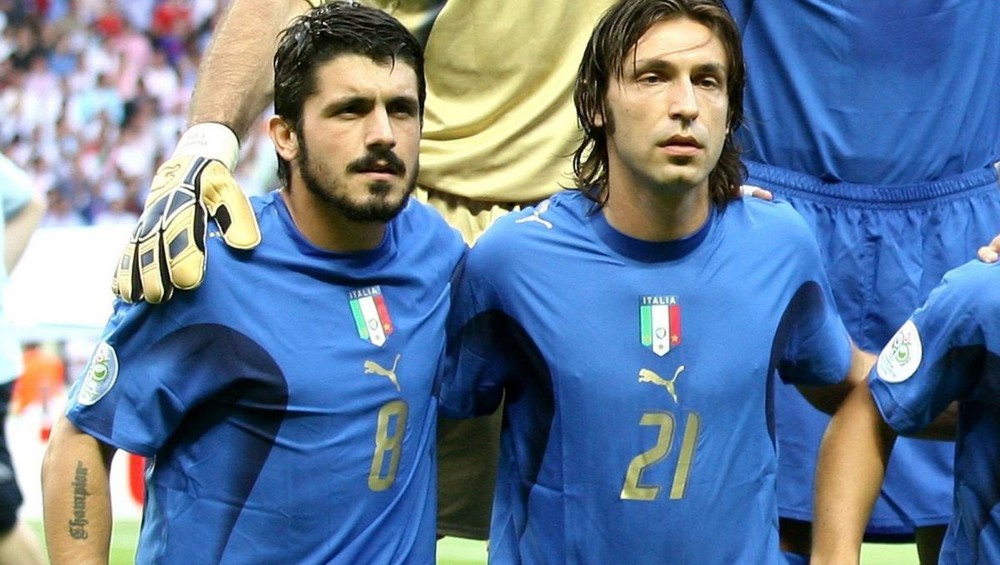
The era when Milan stars were the core of the Italian national team is long gone.
More recently, the EURO 2020 victory—a rare joy amid World Cup disappointments—is marked by Gigio Donnarumma's imprint. His penalty saves in the final against England became iconic. Milan, for many decades, never stood apart from major milestones for the Azzurri.

So what has changed? The answer lies in the personnel structure. Today's Milan, like many other big clubs, has a strong international flavor. The number of Italian players in the starting lineup is not high. In this call-up, names like Mattia Gabbia, Samuele Ricci, or Davide Bartesaghi are only at the "hopeful" level, but ultimately none were selected. When the domestic foundation thins, the contribution to the national team also shrinks.
But the issue is not just about numbers. Milan once possessed an Italian core that served both as a professional backbone and a cultural bridge for foreign stars. Mauro Tassotti, Franco Baresi, Alessandro Costacurta, Paolo Maldini were not just a steel defensive wall but also a standard of spirit, helping Andriy Shevchenko, Kaka, or other champions integrate and maximize their value.
That core is no longer distinct today. And when the "roots" fade, identity also dims. The national team, conversely, reflects precisely that change.
Time passes, and the trend of globalized transfers is irreversible. But in football, the sense of belonging remains a priceless intangible asset. Milan can continue to conquer with a multinational squad, but without a strong Italian foundation, the image of Rossoneri in the blue jersey will increasingly fade.



 Links
Links
 Contact
Address:UNIT 1804 SOUTH BANK TOWER, 55 UPPER GROUND,LONDON ENGLAND SE1 9E
Number:+85259695367
E-mali:[email protected]
 App
App


