



Italy misses the World Cup for the third consecutive time: The most terrifying thing is not the "death"


The Italian national team had considerable favorable conditions before and during the playoff final against Bosnia & Herzegovina, possessed chances to seal the game, but ultimately failed and for the third consecutive time is unable to compete in the World Cup. The current question is: What lies ahead for Italian football following this catastrophe?
How bitter it is that on "International Day of Lies," Italians had to confront a painful truth. "Repeated disaster," "Total catastrophe," "Endless nightmare," or "Unacceptable" are the front-page headlines of the biggest newspapers in the land of pasta after the defeat in Bosnia. Italy fell into the easiest bracket, faced the supposedly easiest opponent (ranked nearly 60 places lower on the FIFA table) and still collapsed.
Who is the culprit behind Italy's nightmare?
Is it Alessandro Bastoni, who received the pivotal red card that completely stripped the Italian team's initiative and confidence on the Bilino Polje pitch, leaving no chance to rectify the mistake? Is it Pio Esposito, who shot the first penalty over the stands, nearly severing the last hopes of the entire football nation? Is it Bryan Cristante, whose penalty hit the crossbar like his predecessor Luigi Di Biagio at the 1998 World Cup, personally shutting the door to the World Cup? Is it Federico Dimarco and Moise Kean, who missed unforgivably golden opportunities to raise the score to 2-0? Is it Coach Rino Gattuso, who made completely directionless substitutions and arranged an incomprehensible penalty shootout order? Or is it Gabriele Gravina, the President of the Italian Football Federation (FIGC) being widely called to resign across the country?
It is all of them, yet none of them individually. This disgraceful disaster was not caused by any single person, but is seen as the inevitable consequence of a decades-long decline process, with reasons not solely confined to football. Consider that Milan and Inter proposed the privatization and reconstruction of San Siro stadium in 2019, but approval only came by late 2025, after endless disputes and power struggles. And the project will be completed earliest by 2029. If approved immediately, the two Milan clubs would already have a new stadium, and its effects might have positively transformed Italian football following Europe's successful model. Even such powerful clubs are trapped for 10 years by bureaucracy, so Gravina, singled out as the "mastermind" of this endless disaster, might also just be a victim.
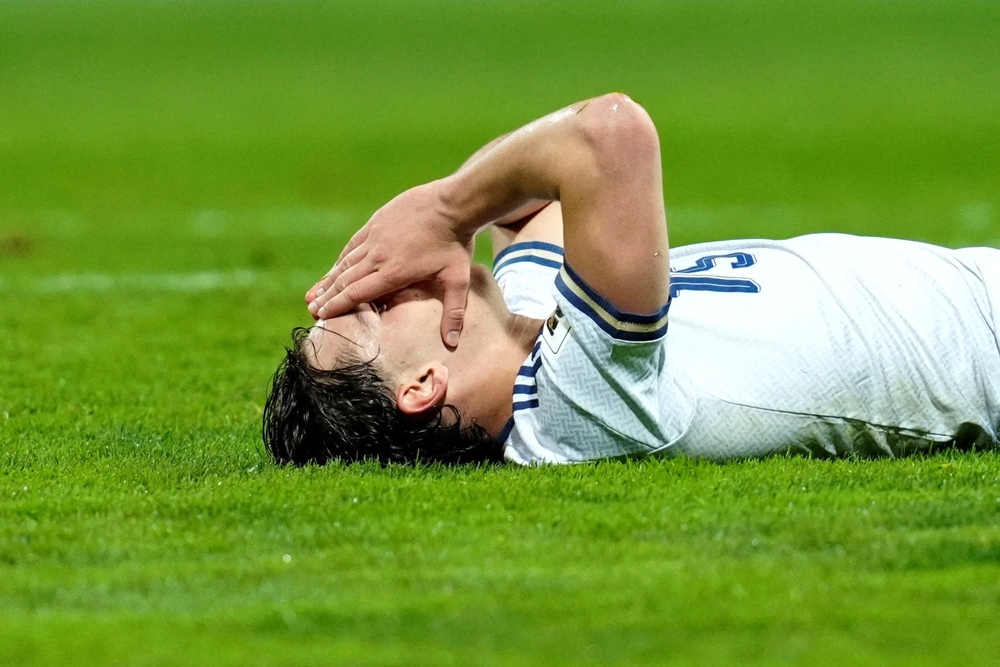
Can Italian football rise from the disaster of missing three World Cups?
What comes after the disaster?
Many viewpoints say this is the actual death of Italian football, the only major football nation in World Cup history absent for three consecutive editions; the only one among Europe's Top 5 not winning the Champions League since 2010; the football system without even one representative in the Champions League quarter-finals in two of the last three seasons; the football that has become a retirement home for fading stars and a landing spot for thousands of mediocre foreign players; the football whose highest league TV rights revenue is even lower than England's second tier; the football with dilapidated stadiums and weekly referee controversies…
Yes, all that paints the gloomy picture of Calcio over the past two decades since the proud 2006 World Cup victory, with consecutive World Cup eliminations becoming the inevitable outcome. Realistic thinkers understand that whether Gravina (or predecessor Carlo Tavecchio) or anyone leads FIGC, whether Spalletti or Gattuso or anyone else coaches the national team, whether Bastoni and Esposito made mistakes or not, this was the unavoidable end for Italian football. Player quality, tactical sophistication, and even Italian football thinking have hit rock bottom for years. Coach Raffaele Palladino's helpless assessment after his Atalanta was eliminated by Bayern Munich 2-10 aggregate in the recent Champions League round of 16, "Seeing them play, I feel we are playing a different sport," is the most genuine reflection of Italian football's current international standing.
But this "death" of Italian football is not the most terrifying thing; the most terrifying is their potential inability to revive. Firing Gravina, firing Gattuso, overhauling the entire management structure and reforming the system—is that enough? A football system is not a house or neighborhood that can be easily demolished and rebuilt. The only certainty is that change is necessary; there is no other path. Italy cannot miss another World Cup before they co-host EURO 2032 (with Turkey), the first major tournament Italy hosts since the 1990 World Cup.
Hope still remains…
Ironically, on the day the Italian national team failed, their youth football brimmed with joy. Italy U21 crushed Sweden U21 4-0 to almost certainly qualify for U21 EURO 2027. Italy U19 drew Turkey U19 1-1 to secure a spot at U19 EURO 2026. Italy U17 defeated Romania U17 2-1 to qualify for both U17 EURO 2026 and U17 World Cup 2026. Italy U18 also leads the U19 EURO 2027 qualification group.
That indicates Italian football's resources are still good across all age groups, meaning hope and revival opportunities are substantial. The issue is how they will utilize and develop those resources. Clearly, a completely different system than the current one is needed to nurture not only young talents, but the future of Italian football.


Wonderfulshortvideo
Mbappe injury mbappe surgery real madrid 0-1 getafe mbappe return date mbappe edit


tottenham relegation tottenham relegated
Rodrygo ACL tear acl injury rodrygo injury real madrid 0-1 getafe
Great defending from Rüdiger 👏
Ganglion cyst removed
max dowman highlights today max downman vs mansfield town arsenal 2-1 mansfield town
User SportScoop has posted a video.
 Links
Links
 Contact
Address:UNIT 1804 SOUTH BANK TOWER, 55 UPPER GROUND,LONDON ENGLAND SE1 9E
Number:+85259695367
E-mali:[email protected]
 App
App


