



Arsenal vs Sporting (first leg 1-0): When "The Gunners" lack both creativity and... basic technique


The 1-2 defeat against Bournemouth in the most recent match clearly exposed the systemic issues that have persisted throughout Arsenal's season.
It is no longer a story of temporary form, but a combination of limitations in attacking thinking and technical errors at a fundamental level.
Excessive timidity
After the match, manager Mikel Arteta mentioned two concepts: composure and readiness. He referenced the moment Vincent Kompany scored the decisive goal for Man City in 2019, a situation where individual factors and decisiveness "created luck." Arsenal currently lacks precisely that: They are not proactive enough to make a difference, increasingly tending to play safe.
One of Arsenal's prominent recent issues is the stagnation in creating chances from live play. Against Bournemouth, they achieved only 0.18 xG (expected goals) from open situations, a figure that clearly reflects the poverty of ideas in execution. Statistics show Arsenal ranks only 16th in the Premier League for accurate pass percentage in their own half (88.8%). This is paradoxical for a team built on a philosophy of playing from the back. When they cannot maintain stability in the initiation phase, they also cannot generate the necessary rhythm to organize attacks.
Previous matches against Sporting, Southampton, or Man City all revealed a familiar pattern: Arsenal controls possession a lot, but lacks breakthroughs, lacks speed, and especially lacks direct attacking options. One clear manifestation is players frequently receiving the ball while facing away from the opponent's goal. When midfield players do not proactively turn and direct the ball forward, the entire attacking system stalls.
Additionally, the lack of off-the-ball movement makes Arsenal even more predictable. Forwards like Gabriel Martinelli, Kai Havertz, or Viktor Gyokeres rarely execute sprints behind the opponent's defensive line.
In a typical situation, Martin Zubimendi receives the ball and looks for a passing option forward. However, ahead of him there is almost no significant movement. No space is created, no pressure is applied on the opponent's defense, forcing Zubimendi to pass sideways.
It is noteworthy that Arsenal used to be very different. In the 2022/23 season, they impressed with a fast, low-touch, and penetration-rich style of play. But currently, the number of passes breaking defensive lines from their own half has significantly decreased. This indicates a clear decline in creative ability from the foundation.
The absence of some key players also has a considerable impact. Odegaard has played only about 37% of Premier League minutes, yet remains among the team's top chance creators. That reflects the high level of dependence on individuals with creative ability. Players who dare to create breakthroughs, like Rayan Cherki of Man City, are precisely what Arsenal lacks.
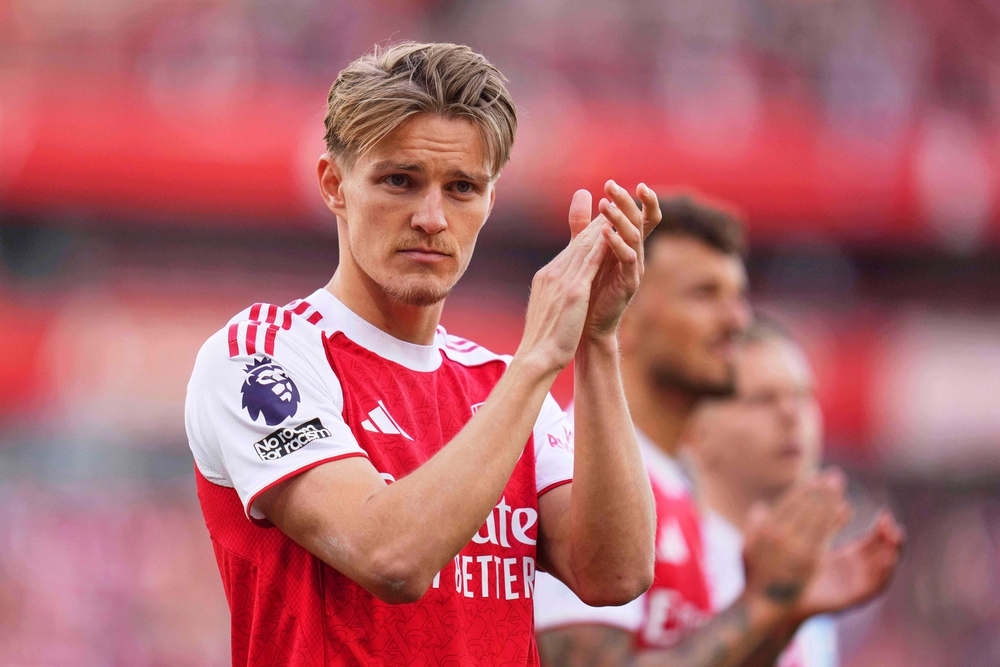
The frequent absence of Odegaard leaves Arsenal distinctly lacking in creativity
The bottleneck causing all ideas to collapse
If creativity is a problem at the conceptual stage, then individual technique is the barrier in execution. The loss to Bournemouth is a clear demonstration of that. Against Andoni Iraola's well-organized high-press system, Arsenal was not completely stuck. They still had moments of successfully escaping the press. However, the problem lies in the subsequent handling phase, where players continuously made errors.
Havertz had an opportunity to receive the ball in a large space, but executed an inaccurate pass. Declan Rice had moments of good handling, but passed too powerfully. Ben White moved according to tactical intent, but could not control the ball.
These seemingly simple errors disrupt the entire system's operation. Instead of utilizing spatial advantages after bypassing the first pressing layer, Arsenal squander opportunities precisely through inaccurate basic handling.
The role of David Raya in ball distribution also deserves mention. As a goalkeeper with good foot skills, Raya was expected to be the starting point for build-up play. However, under significant pressure, he also had instances of inaccurate passes or made unreasonable decisions.
A typical example is when Zubimendi moved intelligently to exploit space behind the opponent's midfield line, Raya executed a pass too powerfully, letting the opportunity slip. In another situation, when a safe short-pass option was available, he chose a long clearance, losing control.
Continuous pressure from Bournemouth caused Arsenal to gradually lose confidence. Decisions became rushed and inaccurate. This further exposed limitations in technique, a factor considered foundational in their style of play.
The decisive conceded goal also originated from a basic mistake. Gabriel had sufficient time to handle the situation but was slow in making a decision, allowing the opponent to close in and steal the ball. Arteta admitted his team did "the basics extremely poorly." This is not an emotional criticism, but an assessment closely aligned with the reality of the match.


Wonderfulshortvideo
👍 OR 👎


No mistake from Dael Fry on the second attempt 🫡
Josh Coburn equalises for Millwall against his former club and look how much he enjoyed that 👏
Josh Coburn - two goals against your former club 👏
Even the wedding ring is @arsenal 😅💍
Omer was a happy man after his side came from behind to win at the Riverside
Oldham’s Ryan Woods wild with this one 🤣
 Links
Links
 Contact
 App
App


