



Is the championship race without suspense becoming an opportunity for the Chinese Super League to rejuvenate?



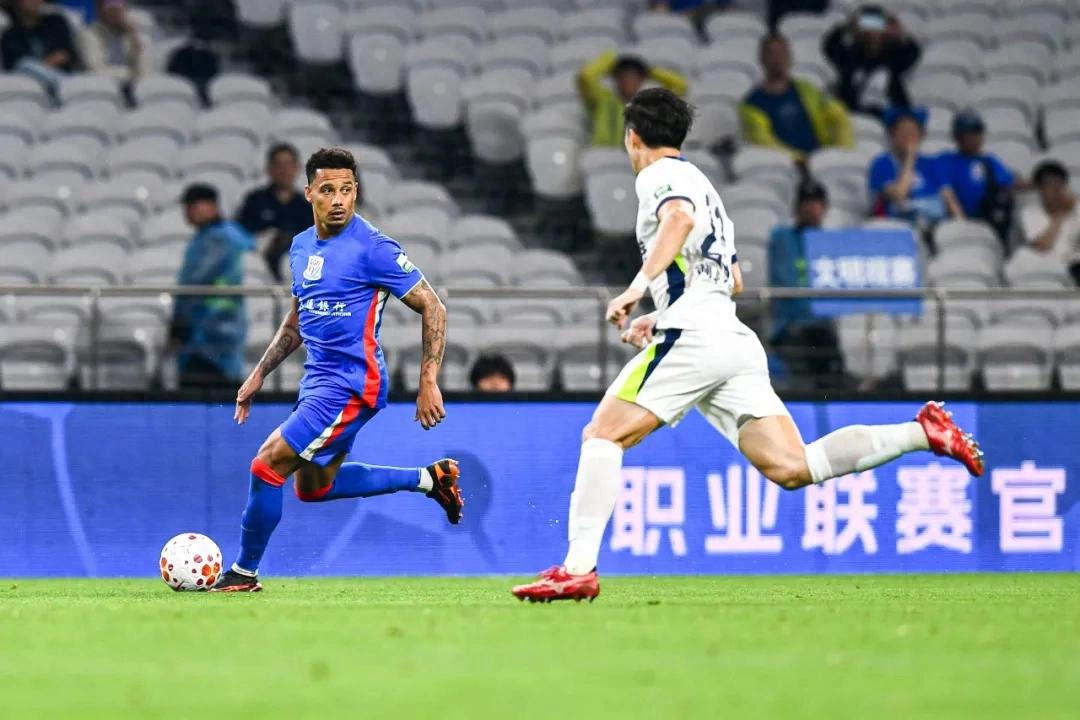
Reporter Chen Yong reports Even the league leader Chengdu Rongcheng experienced an awkward two-match losing streak when their foreign players were hit by injuries. Meanwhile, Shanghai Port and Shanghai Shenhua, though penalized with point deductions early in the season, were still considered contenders by many, but injuries to their foreign players have largely extinguished those prospects. The 2026 CSL season has demonstrated an unprecedented dependence on foreign imports.
With the championship race virtually decided and the relegation battle focused on just three or four teams, many clubs now have a new opportunity: adjusting their age structure, i.e., moving toward a younger squad.

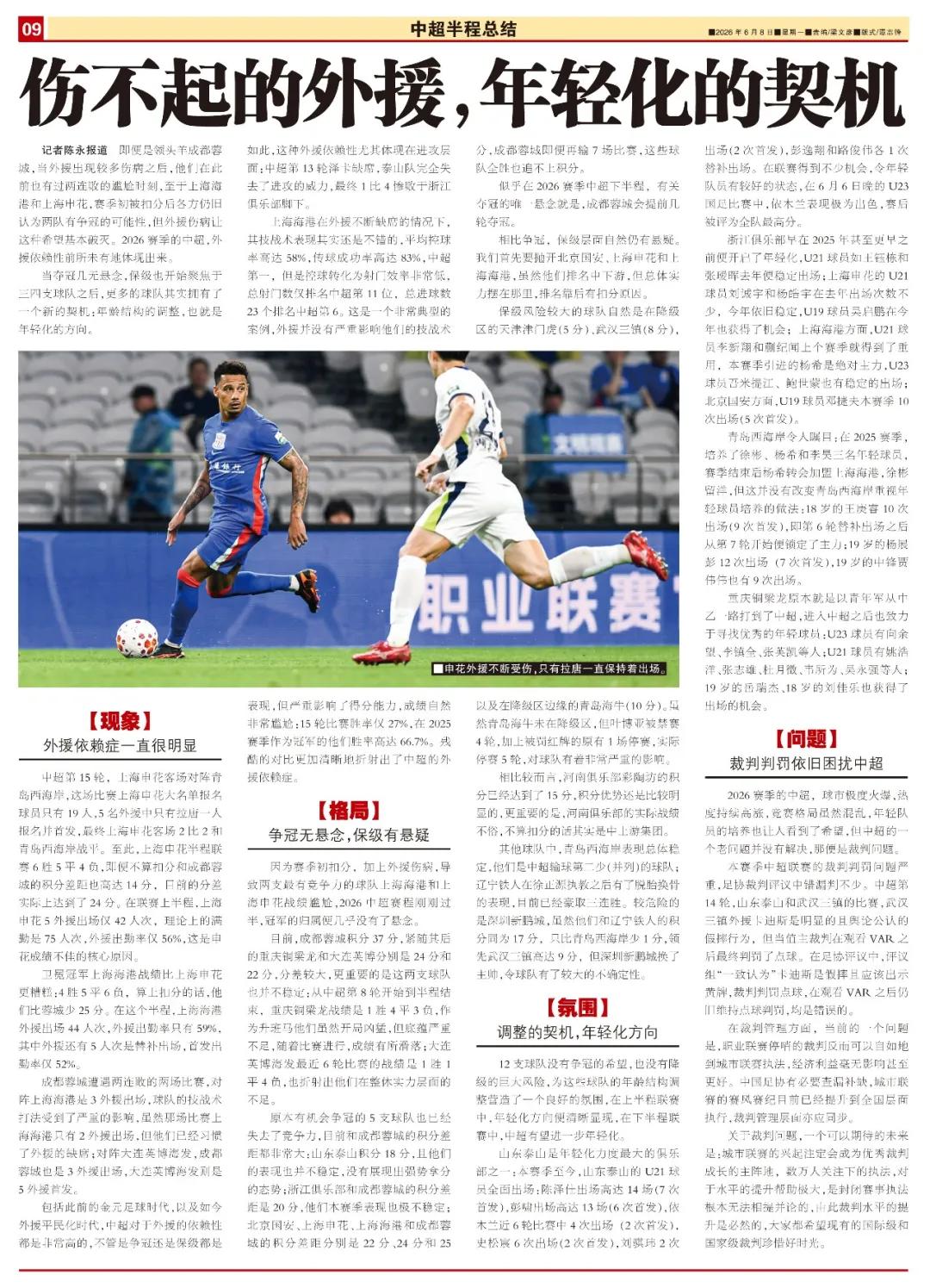
In the 15th round of the CSL, Shanghai Shenhua faced Qingdao West Coast away. Shenhua could only name 19 players in their matchday squad, and only one of their five foreign players—Ladang—was registered and started. The match ended in a 2-2 draw. As of the halfway point of the season, Shanghai Shenhua has 6 wins, 5 draws, and 4 losses. Even without considering the point deduction, they trail Chengdu Rongcheng by 14 points; with the deduction, the gap is a staggering 24 points. In the first half of the league, Shenhua's foreign players appeared in only 42 matches out of a possible 75, a usage rate of just 56%, which is the core reason for their poor results.
Defending champions Shanghai Port have fared even worse: 4 wins, 5 draws, and 6 losses. Including the point deduction, they are 25 points behind Rongcheng. In this half-season, their foreign players made 44 appearances (usage rate 59%), with 5 of those as substitutes. The starting appearance rate is only 52%.
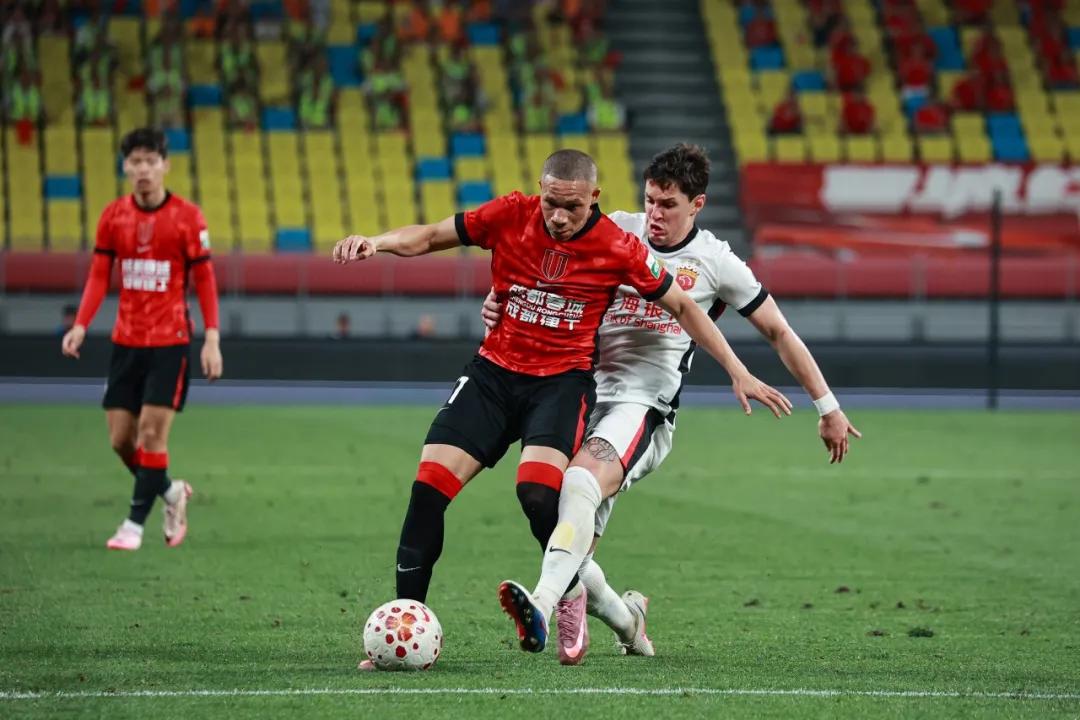
During Chengdu Rongcheng's two consecutive defeats, they had only three foreign players available against Shanghai Port, severely impacting their tactics—though Shanghai Port also had only two foreign players that game, as they have grown accustomed to absences. Against Dalian Yingbo Haifa, Rongcheng again fielded three foreign players, while Dalian started five.
From the era of costly foreign signings to the current more budget-friendly approach, the CSL has always been heavily reliant on foreign players, whether for championship contention or relegation survival. This dependence is especially evident in attack: in the 13th round, without Zeca, Shandong Taishan completely lost their offensive threat, suffering a 1-4 defeat to Zhejiang Club.
Despite frequent foreign player absences, Shanghai Port's tactical performance has been relatively good, with an average possession rate of 58% and a passing accuracy of 83%, both league bests. However, their conversion of possession into shots is very inefficient: total shots rank 11th in the league, and total goals (23) rank 6th. This is a classic example: foreign absences didn't severely disrupt their tactics but significantly hurt their scoring ability, leading to an awkward record—only a 27% win rate over 15 rounds, compared to 66.7% as champions in 2025. Such a stark contrast clearly illustrates the CSL's dependency on foreign players.


Due to early-season point deductions and foreign player injuries, the two strongest contenders—Shanghai Port and Shanghai Shenhua—have struggled. With the 2026 CSL season barely at its halfway point, the championship race is all but decided.
Currently, Chengdu Rongcheng leads with 37 points, followed by Chongqing Tonglianglong (24) and Dalian Yingbo (22). The gap is significant, and both chasing teams lack consistency: from the 8th round to the halfway mark, Chongqing recorded 1 win, 4 draws, and 3 losses. As a newly promoted side, they started strong but lack depth, causing a slump. Dalian Yingbo Haifa has 1 win, 1 draw, and 4 losses in their last six matches, reflecting their overall lack of quality.
The five teams that were originally considered title contenders have also lost ground, with huge gaps to Chengdu: Shandong Taishan has 18 points and is inconsistent, showing no strong run of form. Zhejiang Club trails by 20 points and is similarly unstable. Beijing Guoan, Shanghai Shenhua, and Shanghai Port are 22, 24, and 25 points behind respectively. Even if Chengdu loses seven more matches, those teams would need to win all their games to catch up—an impossible scenario.
In the second half of the 2026 CSL season, the only remaining suspense regarding the title is how many rounds early Chengdu Rongcheng will clinch it.
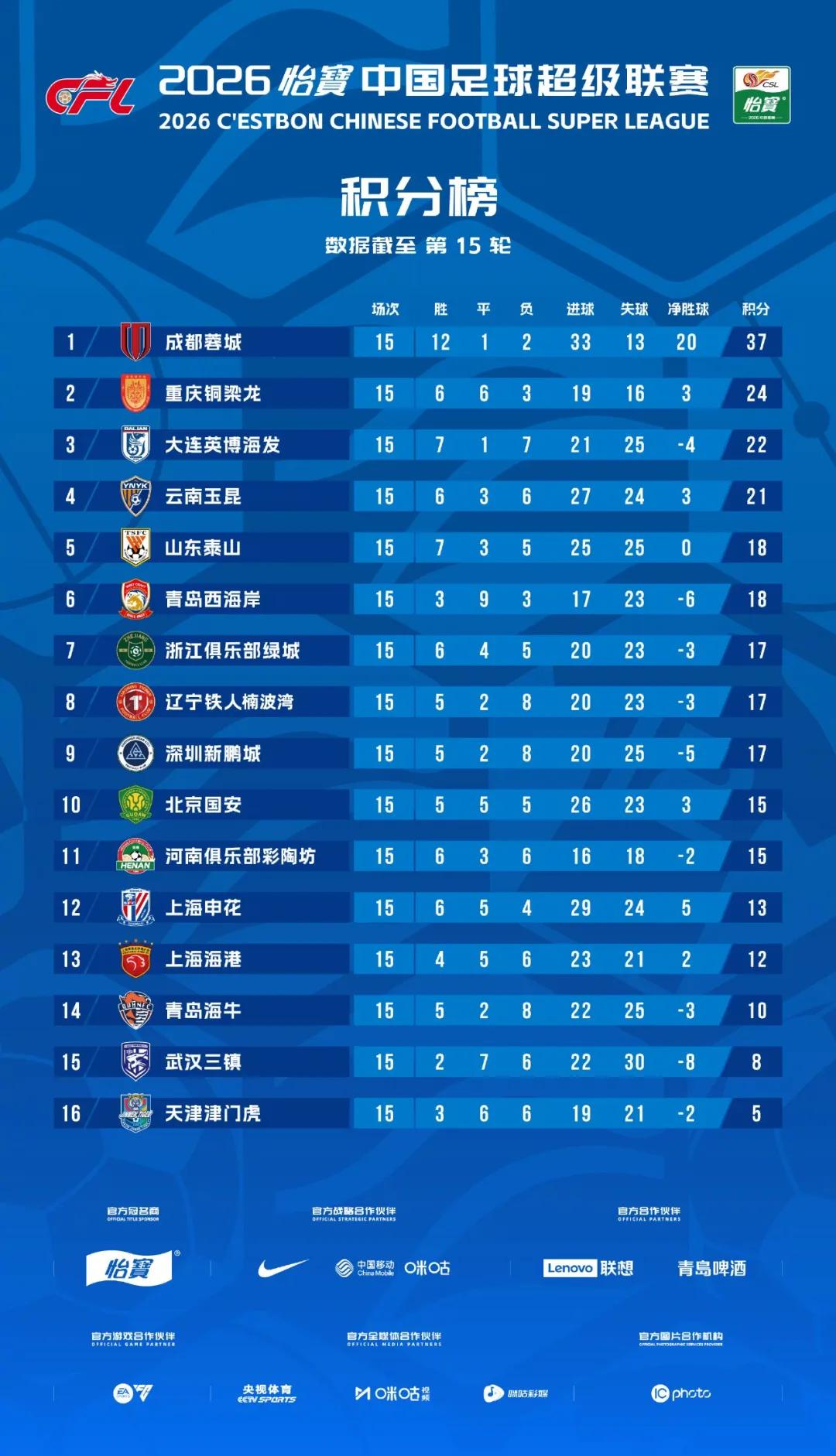
Compared to the title race, the relegation battle still holds some intrigue. We must first set aside Beijing Guoan, Shanghai Shenhua, and Shanghai Port—though they sit in the lower half of the table, their overall strength is clear, and their low positions are partly due to point deductions.
The teams most at risk of relegation are those in the drop zone: Tianjin Jinmen Tiger (5 points) and Wuhan Three Towns (8 points), along with Qingdao Hainiu (10 points) on the edge. Although Qingdao Hainiu is outside the relegation zone, Ye Boya's four-match ban plus a one-match suspension from a red card (totaling five matches) will severely impact the team.
In comparison, Henan Club Caifangfang has 15 points, giving them a comfortable cushion. More importantly, their actual performance is solid; without the point deduction, they would be in the upper mid-table.
Among other teams, Qingdao West Coast has been generally stable—they are tied for the fewest losses in the league. Liaoning Tieren, under coach Xu Zhengyuan, has undergone a transformation, currently on a three-game winning streak. The more precarious side is Shenzhen Xinpengcheng: although they have 17 points (same as Liaoning), just one point behind Qingdao West Coast and nine ahead of Wuhan Three Towns, they have changed their head coach, introducing significant uncertainty.
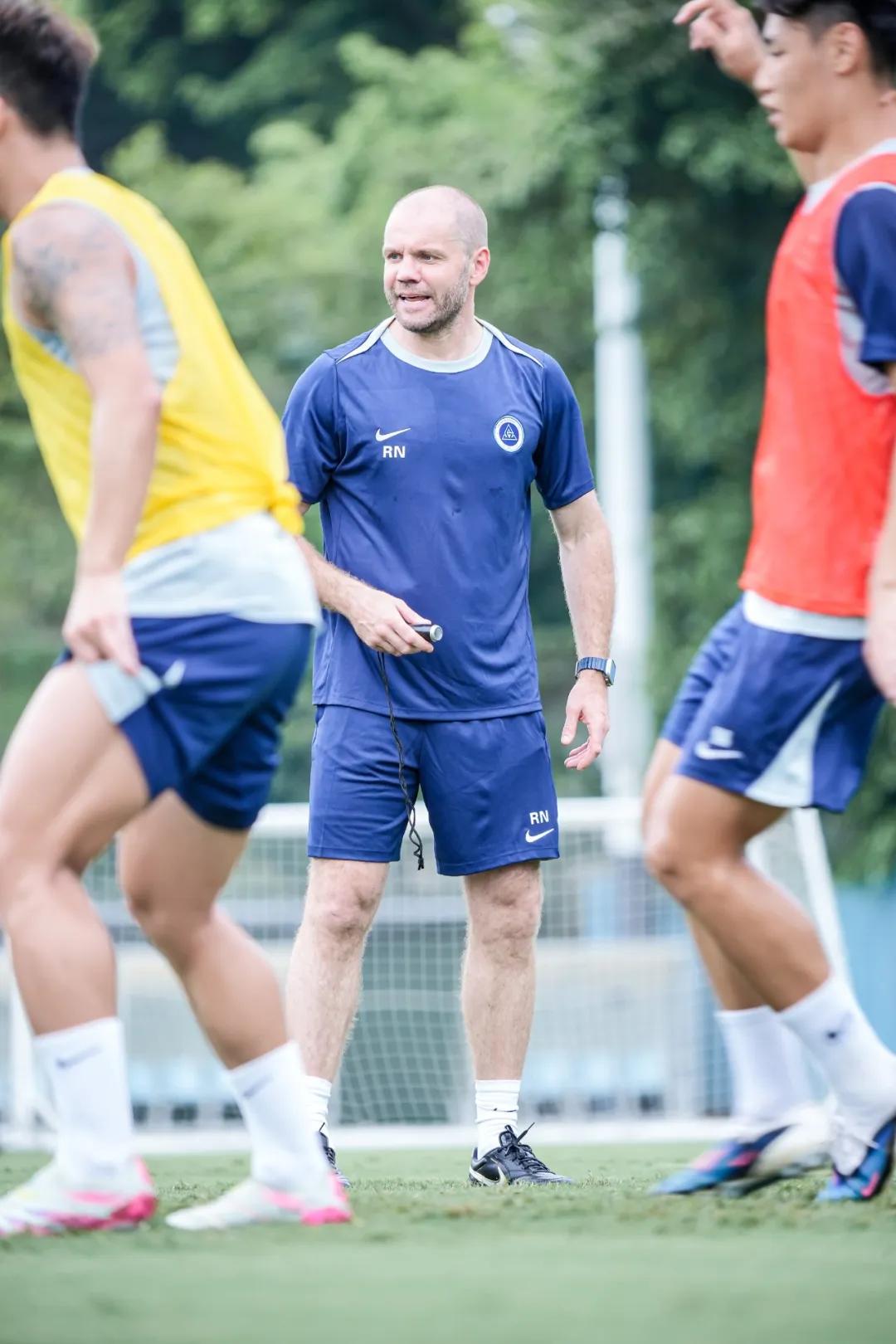

With 12 teams having no hope of winning the title and no serious threat of relegation, a favorable environment has emerged for adjusting age structures. In the first half of the season, the trend toward youth was already clear, and in the second half, the CSL is likely to see further rejuvenation.
Shandong Taishan is one of the clubs pushing hardest for youth: this season, their U21 players have featured extensively. Chen Zeshi made 14 appearances (7 starts), Peng Xiao made 13 (6 starts), Yimulan appeared 4 times in the last 6 rounds (2 starts), Shi Songchen made 6 appearances (2 starts), Liu Qiwei made 2 starts, and Peng Yixiang and Lu Junwei each came off the bench once. This regular playing time has kept young players in good form. In the U23 national team match on June 6, Yimulan performed exceptionally well and was awarded the team's highest rating.
Zhejiang Club began their youth movement as early as 2025 or before, with U21 players like Wang Yudong and Zhang Aihui getting regular minutes last year. Shanghai Shenhua's U21 players Liu Chengyu and Yang Haoyu had many appearances last season and remain stable this year, while U19 player Wu Qipeng has also gained opportunities. For Shanghai Port, U21 players Li Xinxiang and Kuai Jiwen were heavily used last season; this year, new signing Yang Xi is a regular starter, while U23 players Wumitijiang and Bao Shimeng also see consistent playing time. Beijing Guoan's U19 player Deng Jiefu has made 10 appearances (5 starts) this season.
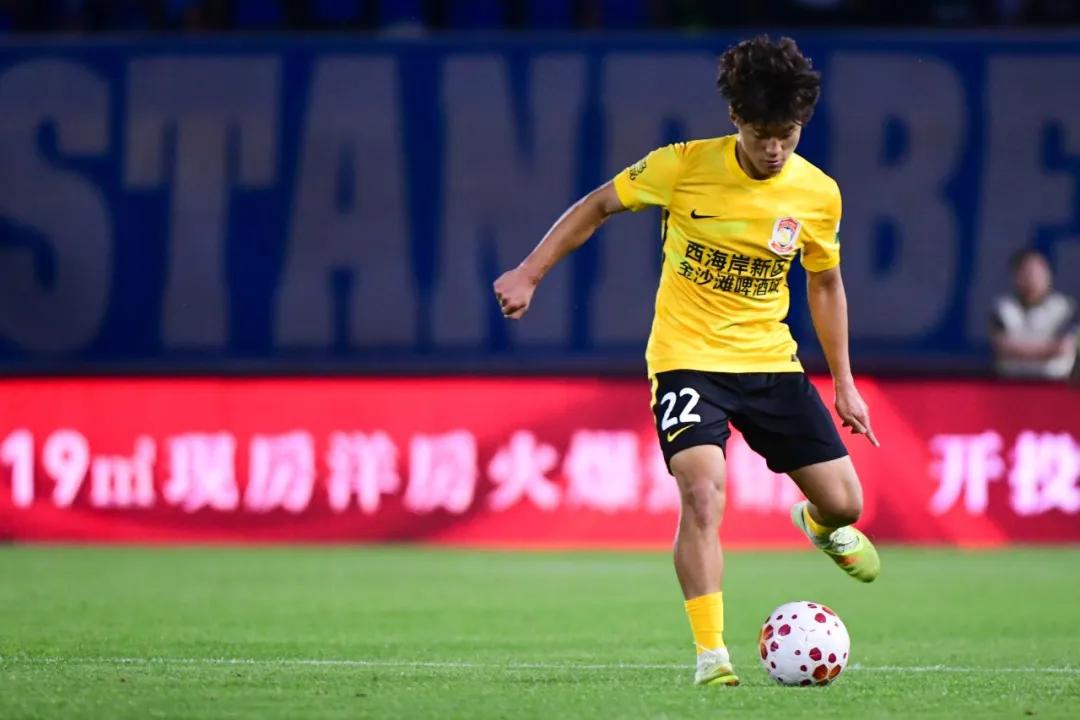
Qingdao West Coast is particularly notable: in the 2025 season, they developed three young players—Xu Bin, Yang Xi, and Li Hao. After the season, Yang Xi transferred to Shanghai Port and Xu Bin went abroad, but this hasn't changed the club's commitment to youth development. 18-year-old Wang Gengrui has made 10 appearances (9 starts), securing a starting spot from the 7th round onward after his debut. 19-year-old Yang Zhanpeng has 12 appearances (7 starts), and 19-year-old striker Jia Weiwei has also made 9 appearances.
Chongqing Tonglianglong originally rose from China League Two to the CSL with a young squad, and they continue to seek talented young players: U23 players include Xiang Yuwang, Li Zhenquan, and Zhang Yingkai; U21 players include Yao Haoyang, Zhang Zhixiong, Du Yuezheng, Wei Suowei, and Wu Yongqiang; 19-year-old Yue Ruijie and 18-year-old Liu Jiale have also gotten playing time.
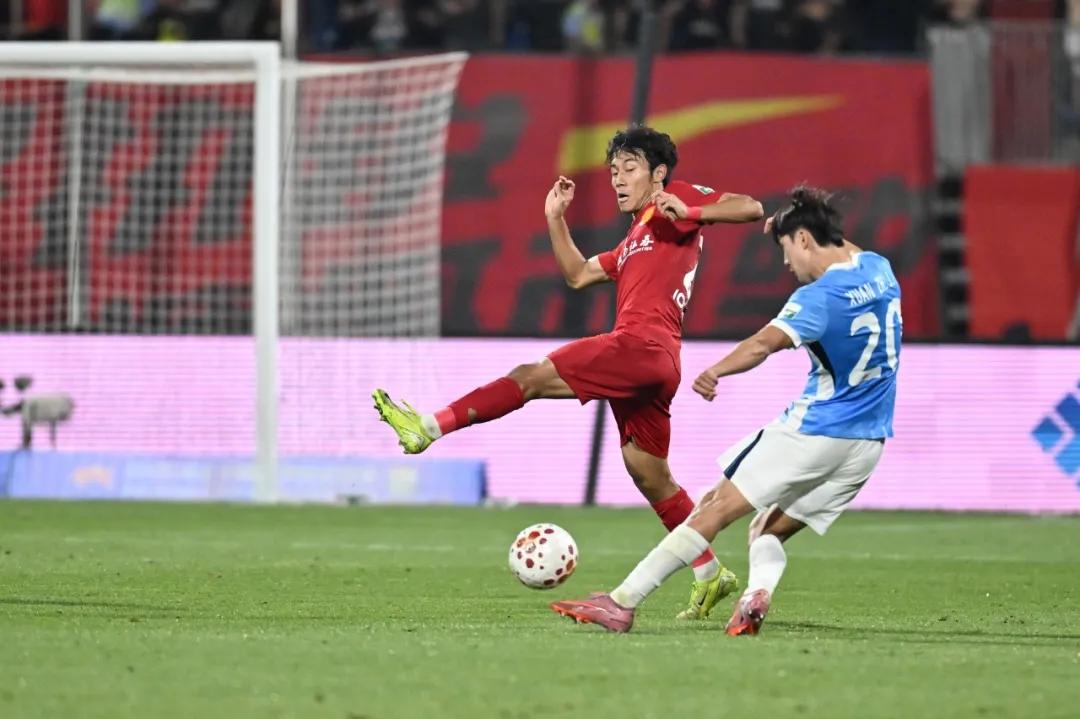

The 2026 CSL season has seen an extremely hot market and soaring fan enthusiasm. Although the competitive landscape is chaotic, the development of young players offers hope. However, an old problem remains unresolved: refereeing.
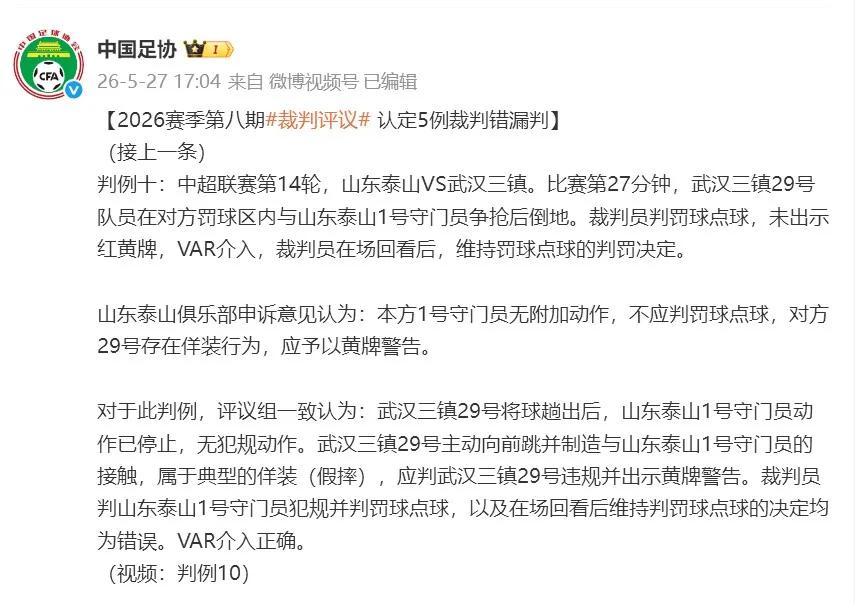
This season, refereeing decisions have been problematic, with numerous errors and omissions in the CFA's own referee reviews. In the 14th round match between Shandong Taishan and Wuhan Three Towns, Wuhan's foreign player Kadiss committed a clear and widely recognized dive, but the referee awarded a penalty after reviewing VAR. In the CFA review, the panel unanimously agreed that Kadiss should have been booked for simulation, and that both the penalty decision and the failure to overturn it after VAR were incorrect.
One current issue in referee management is that referees who are suspended from professional leagues can still freely officiate in city-level leagues without any financial loss—in fact, they may even benefit. The CFA needs to address this loophole. The discipline of city-level leagues is now being enforced at a national level, and referee management should follow suit.
Regarding refereeing, a promising outlook is that the rise of city-level leagues will become a key training ground for excellent referees. Officiating in front of tens of thousands of spectators greatly enhances skill development—something closed-door matches cannot match. Therefore, an improvement in referee quality is inevitable. Everyone hopes that current international and national referees will cherish this opportunity.


Wonderfulshortvideo
Unforgettable EURO moment 🙌


Jude Bellingham. Who else? 🌟

Cristiano and Mateo training

Cristiano's training

an unusual banner

rodri barcelona news rodri barcelona reveal interview

here are the controversial FPL picks that will win you your mini league this season
 Links
Links
 Contact
 App
App


