



From Xi'an to Guizhou, the U23 national team is maturing



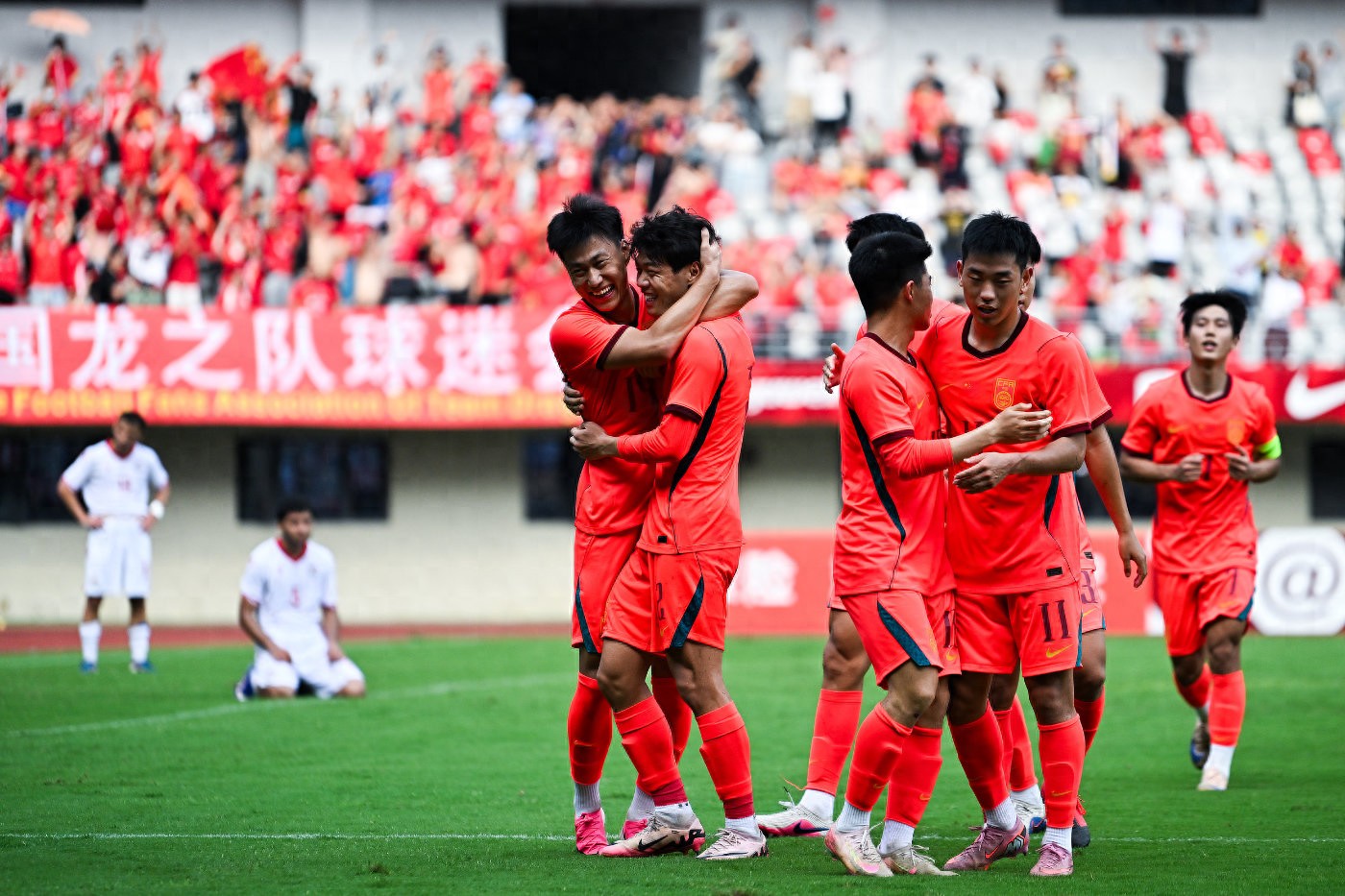
Journalist Lu Mi reports On the afternoon of June 6, in Zunyi, Guizhou, the U23 national team edged out Tajikistan's U23 with a 1-0 victory, courtesy of a 96th-minute header by He Yiran, earning a hard-won opening win in the two-legged tie. The second match will be held in Guiyang at 19:35 on June 9.
The U23 national team will depart for the Asian Games men's football competition this September and is currently in a critical preparation phase. Leveraging two intervals in the Chinese Super League schedule, the Chinese Football Association arranged two warm-up series—one in Xi'an in March and another in Zunyi-Guiyang in June—to provide a high-quality training platform for the team's Asian Games preparations. Compared to the first leg in Xi'an, where the team drew 2-2 with Thailand, the first match against Tajikistan's U23 showcased the growth and improvement of the U23 players after gaining experience in the Chinese Super League.
Two warm-up series, multi-level training
As the U23 national team enters the Asian Games preparation cycle, the Chinese Football Association arranged invitation tournaments in Xi'an and Guizhou as part of a layered training plan to better prepare the team for the Asian Games. This plan addresses the team's shortcomings in three key dimensions: squad integration, tactical implementation, and mental resilience under pressure, with training value running through the entire preparation chain.
From a personnel selection perspective, the U23 national team's matches in these two series overlapped with those of the senior national team, leading to constant rotation in the core lineup. This actually allowed for a full evaluation of the entire candidate pool. During the Xi'an leg in March, many key players were called up to the senior team, forcing the U23 side to rely heavily on substitutes and call up U21 players on short notice, resulting in hasty squad integration. This time, the rotation approach continued, with players such as Xiang Yuwang, Bao Shengxin, He Yiran, and Zhang Zhixiong—who have had consistent playing time in the league—becoming the core. The coaching staff used real matches to screen the Asian Games reserve roster, also addressing the issue of personnel depth for major tournaments.
In terms of opponent selection, Thailand's U23 team epitomizes the fast and agile Southeast Asian style, emphasizing ground passing and control, while Tajikistan's U23 is known for its physicality and counter-attacking approach. The Chinese Football Association chose opponents with distinctly different tactical styles to precisely simulate the characteristics of Asian Games rivals. When facing Thailand in Xi'an, the U23 team tested its coordination and ability to handle technical opponents; this time, against Tajikistan, the focus was clearly on breaking down compact defenses, dealing with physical battles, and solving the problem of attacking against a deep block. Head coach Antonio said: "They are a physical team. We could keep them in their own half for long periods, controlling and passing the ball—that's what we demanded from this match." Judging by the match process, the U23 players indeed achieved that.
From a psychological standpoint, playing consecutive come-from-behind or stalemate games is an essential lesson for young players. In the Xi'an opener, the team fell 0-2 behind before fighting back to draw; in Zunyi, they struggled to break the deadlock before scoring in stoppage time. These two tough matches honed the team's ability to avoid collapsing under pressure and to stay calm during stalemates—a vital mental quality for the Asian Games—accumulating valuable experience for potential adverse situations and tight contests.
From panic to composure, a calmer mindset
In the March match against Thailand in Xi'an, the U23 national team enjoyed nearly 70% possession but conceded two goals in the first half. Defensive coordination was poor, midfield passing was sluggish, and the forwards missed several good chances. Although they managed to equalize in the second half with goals from Xiang Yuwang and Li Xinxiang, the overall rhythm of attack and defense was chaotic. The players seemed flustered when facing quick opponent interplays and lacked solutions against high pressing. However, the team had just undergone a major personnel overhaul at that time, with insufficient integration and an unformed system. The comeback relied more on individual brilliance.
This time around, against Tajikistan, the U23 team controlled 73% of possession, had a passing accuracy of over 85%, recorded 11 shots with 3 on target, while the opponent managed only one long-range effort. They dominated the game from start to finish, with the defensive line making no major mistakes. The backline, led by Wu Mitijiang and He Yiran, performed solidly. Although they failed to score for a long time despite sustained pressure, and Xiang Yuwang missed several close-range chances, the team did not grow impatient. After coming off the bench, Zhang Zhixiong delivered a precise cross, and He Yiran rose to nod in a last-gasp header. The entire attacking sequence aligned perfectly with the coaching staff's tactical plan.
The Xi'an match against Thailand was a desperate fightback after being on the back foot, mainly because the team was undergoing a reshuffle following the U23 Asian Cup, with significant personnel changes and insufficient cohesion. This time, after reassembling, the team appeared much more stable and solid, with noticeably improved tactical execution. This is a direct reflection of the U23 players' growth—they have become more rational and composed in their decision-making after gaining experience in the league.
Guiyang rematch: honing the finishing ability of the forward line
The two teams will move to Guiyang for the second leg. The 1-0 first-leg victory cannot mask the team's shortcomings in breaking down a stubborn defense. The second match will serve as an excellent opportunity to identify weaknesses and refine tactics.
Finishing efficiency has been a persistent issue for this team since the U23 Asian Cup. In that tournament, across three group stage matches and the first knockout round, they scored only one goal in four games—a header by defender Peng Xiao. During the Xi'an leg, forwards like Xiang Yuwang, Li Xinxiang, and Du Yuezheng all found the net, suggesting some improvement. However, in this first match against Tajikistan, the U23 team had 11 shots and 8 corners but still only managed to score in the 96th minute, indicating that the forward line's conversion ability remains weak.
In the second leg against Tajikistan, it is expected that Antonio will continue to rotate the squad, testing combat readiness in high-intensity real matches and rehearsing the Asian Games lineup. In the first leg, Tajikistan's U23 adopted a tactic of dropping deep and counter-attacking. In the second leg, they might increase the intensity of their high press. If so, this will further test the U23 team's physical and physicality under pressure.


Wonderfulshortvideo
Unforgettable EURO moment 🙌


Jude Bellingham. Who else? 🌟

Cristiano and Mateo training

Cristiano's training

an unusual banner

rodri barcelona news rodri barcelona reveal interview

here are the controversial FPL picks that will win you your mini league this season
 Links
Links
 Contact
 App
App


