



ASEAN CUP 2026: A New Melody and Old Tunes



Thirty years have passed since the Tiger Cup 1996 was first held in Singapore, and Southeast Asian football has traveled a long journey under various names, from Tiger Cup to AFF Cup and now ASEAN Cup.
The tournament has turned 30, with continuous efforts to change, from the organization format to shifting the competition schedule to summer in line with the European structure. Yet, after the opening matches of the ASEAN Cup 2026, looking at what is happening on the regional pitches, fans cannot help but sigh: It’s still the same old stories; any progress, if any, is limited, or even stagnant, in a "village pond" that has yet to become a vast ocean.
Looking too far might be forced, so let’s focus on nearly two years ago. Timor Leste started with a 0-10 defeat at Hang Day, where they chose to play as hosts against defending champions Thailand. Now, playing in Chonburi, they lost 0-7 to defending champions Vietnam. That was because Vietnam still didn’t fully capitalize on all their 22 shots on goal. As for Laos, at the ASEAN Cup 2024 they lost 1-4 to Vietnam, and now they lost 0-5 to Thailand, both at home. If there is any sign of progress, it might be in the average age of Laos and Timor Leste, both being the youngest in the tournament, with most players being U23.
Timor Leste’s coach Jose Pedro had to admit a bitter reality: Vietnam is completely superior to them. Meanwhile, Thailand beat Laos 5-0, but was still criticized by domestic media for lacking desire. These "unbelievable" scores show that the gap between the bottom and top groups of Southeast Asian football has not been narrowed, even though the tournament has gone through 16 editions.
That’s the story of the "small nations" in the region. Now let’s talk about the "potential group," meaning teams that are improving or have been part of Southeast Asian football history. A typical example is Cambodia, who played a hard-fought opening match against Singapore at the Morodok Techo National Stadium.
With the debut of Brazilian-born midfielder Iago Bento, the Temple Pagoda team had moments of good ball control and equalized 1-1 emotionally. But then, as their stamina dropped after the 65th minute and they faced moments requiring high concentration, they suffered a painful loss in the 10th minute of second-half stoppage time after a spectacular goal by Ilhan Fandi. Similarly, Myanmar took an early lead against Malaysia, but the brilliance of another Brazilian-born player, Paulo Josue, on the opponent’s side led to a 1-2 comeback defeat.
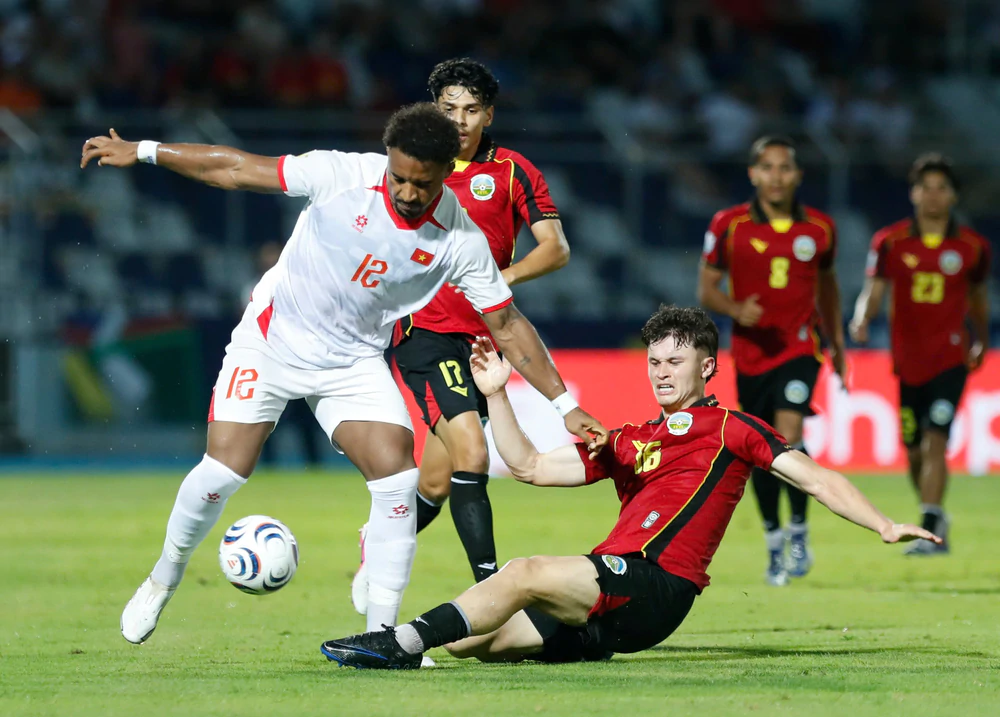
After many years of the Tiger Cup/AFF Cup/ASEAN Cup, the gap in quality between the top and bottom teams has not been significantly narrowed. Photo: Tuan Pham
The losses of Cambodia and Myanmar share a common point: They could only play their best football for about 60 minutes. But even in those 60 minutes, apart from their passionate spirit, technical factors such as passing accuracy, decision-making in the final third, 1v1 duels, and counter-attack precision... were no different from before. That means, looking at the overall balance of the game, Cambodia and Myanmar seemed equal to Singapore and Malaysia. The problem is that their opponents still won in the end, even though the technical stats were not better.
That’s exactly the issue. Even when former champions like Singapore or Malaysia are in a low cycle, the "potential" teams still cannot cause an upset. The reason is quite simple: Their weaknesses in physicality, tactics, and individual skills are nothing new. New players, but old thinking; maybe things are only better in terms of spirit.
There’s not much to say about the contenders after the first round. The victories came too easily, making the records seem more statistical than a confirmation of a breakthrough in quality. For example, Nguyen Dinh Bac becoming the third Vietnamese player to score a hat-trick in the ASEAN Cup doesn’t say much when the opponent was Timor Leste. Meanwhile, Thailand maintaining a record of 16 unbeaten opening matches in tournament history, scoring 61 goals and conceding only 12 across all opening rounds, only confirms that no matter how much the "War Elephants" decline, they are still among the top two in the region.
So, we might hear a new arrangement, a melody that seems fresh and timely, but ask yourself: Compared to the 1996 Tiger Cup, what is different about this opening 30 years later? Or is it just the same old song that fans have memorized, only hoping to wait for the semifinals, where the classic rivalries happen, to find a genuine emotion?
The ASEAN Cup 2026 tried to change by moving the schedule to July, the summer period, but ultimately, it was just a technical adjustment, not affecting the story of the tournament. The goal of comprehensively elevating an entire football backwater, which the organizers aimed for three decades ago, still seems to be "circling around a realm" with the same old faces, the same old scripts, and a feeling that is not yet old.


Wonderfulshortvideo

vinicius junior transfer real madrid arsenal vini here we go arsenal news today real madrid news today ronaldo real madrid ronaldo edit



A sneak peak at yesterdays opener 👀

Think we might side with Francesca’s idea 😂

The highs & lows of racing 🐎

A different view to yesterday’s Stewards enquiry 👀

Perfectly explained by Francesca 🫶🏻

Keep an eye out for Adaay of Scarlett 👀
 Links
Links
 Contact
 App
App


