



ASEAN Cup and the 'village pond' is already crowded



The 'seven-star' triumph of the Vietnamese team and the actual level of the 16th ASEAN Championship (ASEAN Hyundai Cup 2026) are major concerns for fans immediately after the first round of matches.
One day after the devastating performance of coach Kim Sang Sik's team against Timor Leste, defending champions Thailand also took the field and easily crushed hosts Laos 5-0. Without waiting for the other heavyweight candidate Indonesia to play, it is clear that after three decades, this tournament has essentially not changed in nature.
It still seems to be the exclusive playground of the 'big five' group consisting of Thailand, Singapore, Vietnam, Malaysia, and Indonesia. While Thailand has won the title 7 times, Singapore 4 times, Vietnam 3 times, Malaysia also once touched the Golden Cup (2010).
As for Indonesia, despite remarkable progress in recent years thanks to a strong wave of naturalization, they still miss out on the Southeast Asian championship. However, the island nation seems no longer too keen on this title, as their ultimate goal has shifted to the Asian Cup and a ticket to the World Cup finals.
This reality forces us to ask: Should the Southeast Asian Championship be maintained every two years? A tournament with such a disparity in professional quality, a schedule that drags on for a whole month consuming both financial and human resources, while the overall development impetus for football is very limited.
At this point, the ambitions of the top regional football nations like Vietnam, Thailand, and Indonesia have clearly gone beyond the borders of Southeast Asia.
There has been news that the regional tournament system will undergo groundbreaking changes in the future to improve professional quality. If that happens, this year's tournament may well be the final chapter for an old format, closing a journey exactly 30 years since the first Tiger Cup in 1996.
Returning to the developments in the first round of group stage. Vietnam and Thailand, with superior squad quality and thorough preparation, have proven they are too strong for the rest.
The gap is so large that winning seems like a pre-programmed script. In the context of this year's tournament being held during the break between two V-League seasons, it is nothing more than a light training session for coach Kim Sang Sik's players.
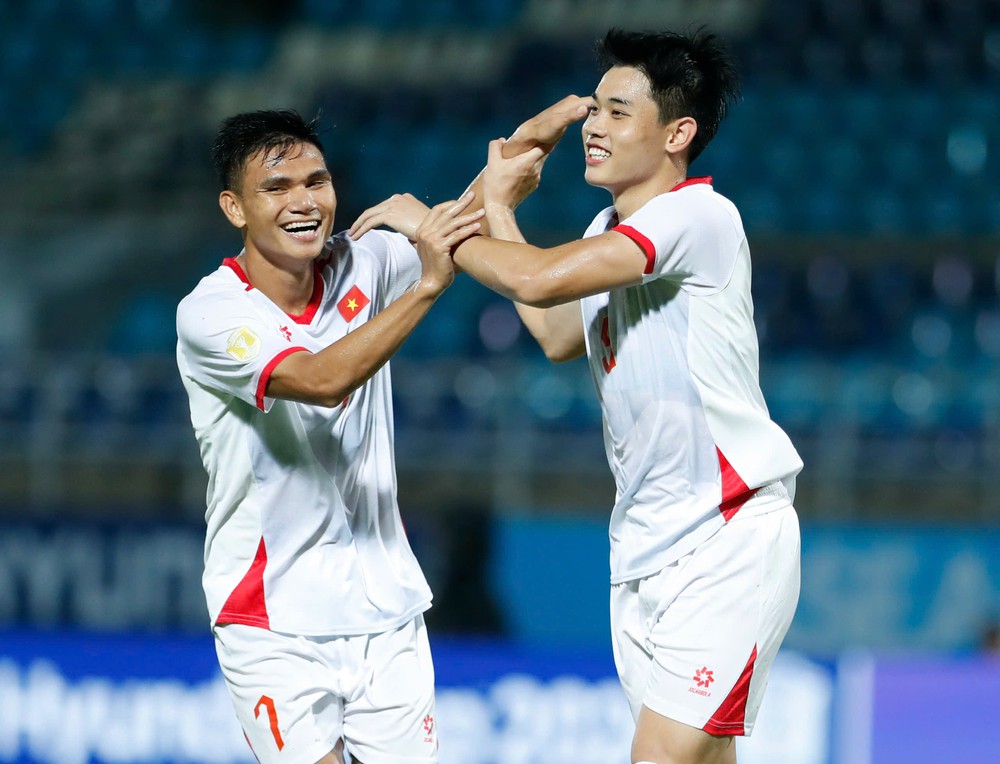
It is time for Vietnamese football to confidently set big goals at the 2027 Asian Cup and the 2030 World Cup Qualifying campaign. Photo: Tuấn Phạm
Looking at the current core squad with top stars like Nguyen Xuan Son, Do Hoang Hen, Nguyen Dinh Bac, Nguyen Quang Hai, Nguyen Hoang Duc, Doan Van Hau, Nguyen Thanh Chung, and goalkeeper Patrik Le Giang..., Vietnamese football clearly needs a higher and more fierce arena to define its value. That arena must be the upcoming 2027 Asian Cup finals in Saudi Arabia, a heavy fire test against continental giants.
Therefore, the overwhelming statistics in the recent victory over Timor Leste do not carry much professional value. The focus of Group A truly begins when Kim Sang Sik's team faces Singapore on July 31 and directly confronts arch-rivals Indonesia on August 3. However, with the current superior squad depth, securing a ticket to advance is not too challenging for the Golden Star warriors.
The vision of Vietnamese football needs to be placed in a long-term and systematic campaign. The VFF's plan to send the youth team to the upcoming ASIAD in Nagoya (Japan) is a reasonable step to train players for the goal of competing for an Olympic ticket. Look back at the historic milestone at the 2018 ASIAD in Indonesia, where we reached the semi-finals and had a fierce clash with the South Korean Olympic team of superstar Son Heung Min. That was the perfect launchpad that created a golden generation, proudly taking Vietnamese football into the third round of the Asian World Cup qualifiers.
As Thể thao & Văn hóa analyzed in the previous issue, with reasonable strategic planning, a harmonious combination of steady young blood, experienced veterans, and high-quality naturalized players, we can confidently set big goals at the 2027 Asian Cup and the 2030 World Cup Qualifying campaign.
What needs decisive change in direction must be decided right now. It is time for Vietnamese football to temporarily forget the moderate glories at the ASEAN Cup or SEA Games and focus all efforts on the bigger sea!


Wonderfulshortvideo

vinicius junior transfer real madrid arsenal vini here we go arsenal news today real madrid news today ronaldo real madrid ronaldo edit



A sneak peak at yesterdays opener 👀

Think we might side with Francesca’s idea 😂

The highs & lows of racing 🐎

A different view to yesterday’s Stewards enquiry 👀

Perfectly explained by Francesca 🫶🏻

Keep an eye out for Adaay of Scarlett 👀
 Links
Links
 Contact
 App
App


