



Thailand Team: A Big Win, but Concerns Remain



The 5-0 triumph against Laos provided Thailand with a highly favorable beginning to the ASEAN Cup 2026. The young players' brilliance offers fans of the "War Elephants" grounds for optimism following a time of uncertainty. However…
… A resounding victory is not enough to confirm that Thailand has overcome its personnel crisis or completed the generational transition.
The Young Squad Brings Hope
Thailand's biggest positive from the win over Laos lies not in the five-goal margin, but in the individuals who delivered that result.
Kakana Khamyok, just 22 years old and making only his third national team appearance, scored an impressive brace. Yotsakon Burapha (21) continued to demonstrate the potential of a modern striker with intelligent movement. Teerasak Poeiphimai (23) also got his name on the scoresheet. Among Thailand's five goals, only Sarach Yooyen (34) belongs to the veteran generation.
That is the image Thai fans have been waiting for years. After a series of failures in finding successors for the golden generation of Chanathip Songkrasin, Theerathon Bunmathan, and Teerasil Dangda, the "War Elephants" are finally seeing positive signals from the post-2000 generation of players.
That victory also partly reflects the philosophy head coach Anthony Hudson is pursuing. The English manager has stated that no starting spot is given based on reputation or age. Everyone must compete fairly on the training ground and prove their ability whenever given the opportunity.
That message was clearly demonstrated on the pitch. Young players are no longer playing supporting roles as in previous years but have truly become decisive factors in the match outcome. This is perhaps the biggest achievement Hudson has gained from the opening match, because a heavy win over Laos is not particularly surprising, but the way young talents know how to shine is what carries real significance for the future.
However, this is where the first major question arises: Is that performance convincing enough when the opponent was only Laos?
The Real Test Still Lies Ahead
If we put the match in the proper context, Thailand's 5-0 victory is not necessarily a statement of strength. Laos is considered the weakest team in Group B. The gap in quality between the two football nations has existed for many years and was clearly reflected on the field. Things became even easier for the "War Elephants" when defender Phetdavanh Somsanid received a straight red card at the end of the first half, forcing the hosts to play with ten men for the entire second half.
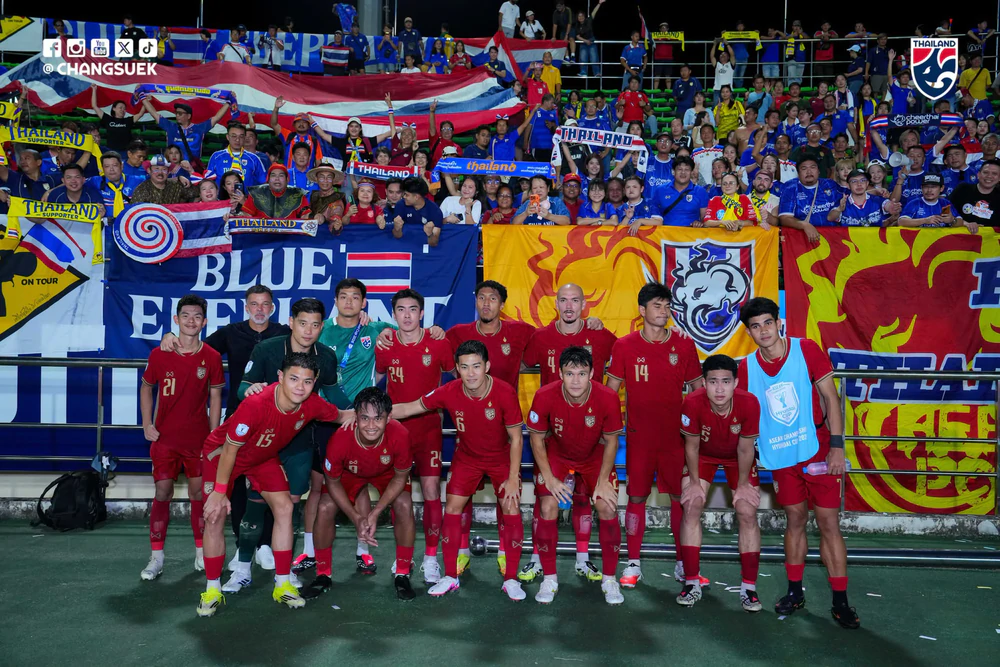
Thailand needs stronger tests than Laos. Photo: Changsuek
In a completely dominant game, Thailand scoring more goals was almost a natural consequence. In other words, if they had not won big in that situation, it would have been surprising. Therefore, it is too early to see this victory as evidence that Thailand has returned to its dominant position in Southeast Asia.
Malaysia just came from behind to beat Myanmar away. With the return of Tan Cheng Hoe—who led Malaysia to the runner-up spot in 2018—this team is gradually forming a more cohesive style after a rebuilding process. The Philippines continue to have a young squad trained in Europe, with strong physicality and speed. Even Myanmar can cause surprises in high-intensity matches. Those are the opponents capable of forcing Thailand to reveal all its strengths and weaknesses.
Easy wins over weak teams carry little reference value for the championship race. Therefore, the upcoming match against Malaysia will be the first real test for the ambitions of Hudson and his team.
The Oldest Team in the Tournament and the Chanathip Void
Despite the strong impression made by young players on the opening day, Thailand still has the highest average age in the ASEAN Cup 2026: 28.4.
Overall, Hudson still relies heavily on the veterans. The starting lineup against Laos still included seasoned players like Sarach Yooyen (34), Kampol Pathomakkakul (34), Nattapong Sayriya (34), Manuel Bihr (32), and Narubadin Weerawatnodom (32). This shows that the generational transition in Thai football has only taken place in a few positions, rather than becoming a true revolution.
This reality stems from a familiar cause over the years: clubs not releasing players for the national team. The ASEAN Cup 2026 continues to see the absence of many key players such as Chanathip Songkrasin, Theerathon Bunmathan, Supachok Sarachat, Supachai Chaided, Kritsada Kaman, and many other players who are either playing abroad or serving their clubs. These are all players who have defined Thailand's identity over the past decade.
That void is not yet apparent when the opponent was only Laos. But when entering matches that require composure, the ability to control the tempo, and make a difference in decisive moments, the Thai people will probably miss Chanathip with his creative handling, miss Theerathon with his ability to regulate the game from the back, or Supachok with his explosive moments upfront. The victory over Laos cannot erase the fact that Thailand is still in a precarious transition period, where youth has only shone in a few positions while the foundation still depends on veterans, and many of the best stars are absent.
Thailand's Special Record
Thailand maintains an unbeaten record in 16 opening matches in 16 ASEAN Cup editions in history. Specifically, they have 12 wins, 4 draws, scoring 61 goals and conceding only 12 goals in opening matches. Notably Notably: In the last 5 opening matches, Thailand has a goal difference of… 29-0, as they only faced "minnows" of the tournament. Apart from Thailand, no team is unbeaten in opening matches at the ASEAN Cup. The second best in this statistic is Vietnam (10 wins, 5 draws, 1 loss, scoring 51 goals, conceding 13). Their only defeat was a 0-2 loss to Thailand at Rajamangala Stadium in the 2018 AFF Cup.


Wonderfulshortvideo

vinicius junior transfer real madrid arsenal vini here we go arsenal news today real madrid news today ronaldo real madrid ronaldo edit



A sneak peak at yesterdays opener 👀

Think we might side with Francesca’s idea 😂

The highs & lows of racing 🐎

A different view to yesterday’s Stewards enquiry 👀

Perfectly explained by Francesca 🫶🏻

Keep an eye out for Adaay of Scarlett 👀
 Links
Links
 Contact
 App
App


