



The expansion and restructuring of the AFC Champions League Elite to version 2.0 demands full commitment from the Chinese Super League.




By Han Bing. On July 30, the AFC officially announced important decisions regarding several tournaments. In addition to determining the host cities for the 2027 and 2029 U17 Asian Cups, the 2028 U23 Asian Cup, and the ACL finals for three consecutive years (2027–2029), the AFC also revealed the new ACL format. From the 2026/27 season, the ACL will be expanded to 32 teams, using a variant of the Swiss system. This marks the completion of the ACL's version 2.0 upgrade. For Port Shanghai and Beijing Guoan, representing the CSL, this presents a prime opportunity to earn more points for the league and secure higher prize money for themselves.

As early as April 24, the AFC had confirmed that starting from the 2026/27 season, the ACL would expand from 24 to 32 teams. With more teams in the league stage than the Copa Libertadores (28 teams), it now ranks second only to the UEFA Champions League (36 teams) among top-tier continental club competitions globally. The new slots are distributed toward the extremes: top-tier leagues with higher rankings receive more quotas, while the expansion also extends downward. Jordan and Vietnam, respectively ranked seventh in the West and East zones, have gained entry, increasing geographic coverage.
Saudi Arabia and Japan, ranked first in the West and East zones, each received a 4+1 quota. Saudi's Al-Ahli and Japan's Gamba Osaka qualified as defending champions of the ACL and AFC Cup 2, respectively. In the East zone, Japan's four direct league-stage slots go to the top three of the 2025 J1 League—Kashima Antlers, Kashiwa Reysol, and Kyoto Sanga—plus the 2025 Centennial Special Edition J1 League champion Vissel Kobe. Gamba Osaka will enter the playoffs. For South Korea, the K1 League champions and runners-up from last season, Jeonbuk Hyundai and Daejeon Hana Citizen, along with fourth-placed Pohang Steelers, go straight to the league stage. Third-placed Gimcheon Sangmu is ineligible for AFC competitions, so fifth-placed Gangwon FC replaces them in the playoffs.
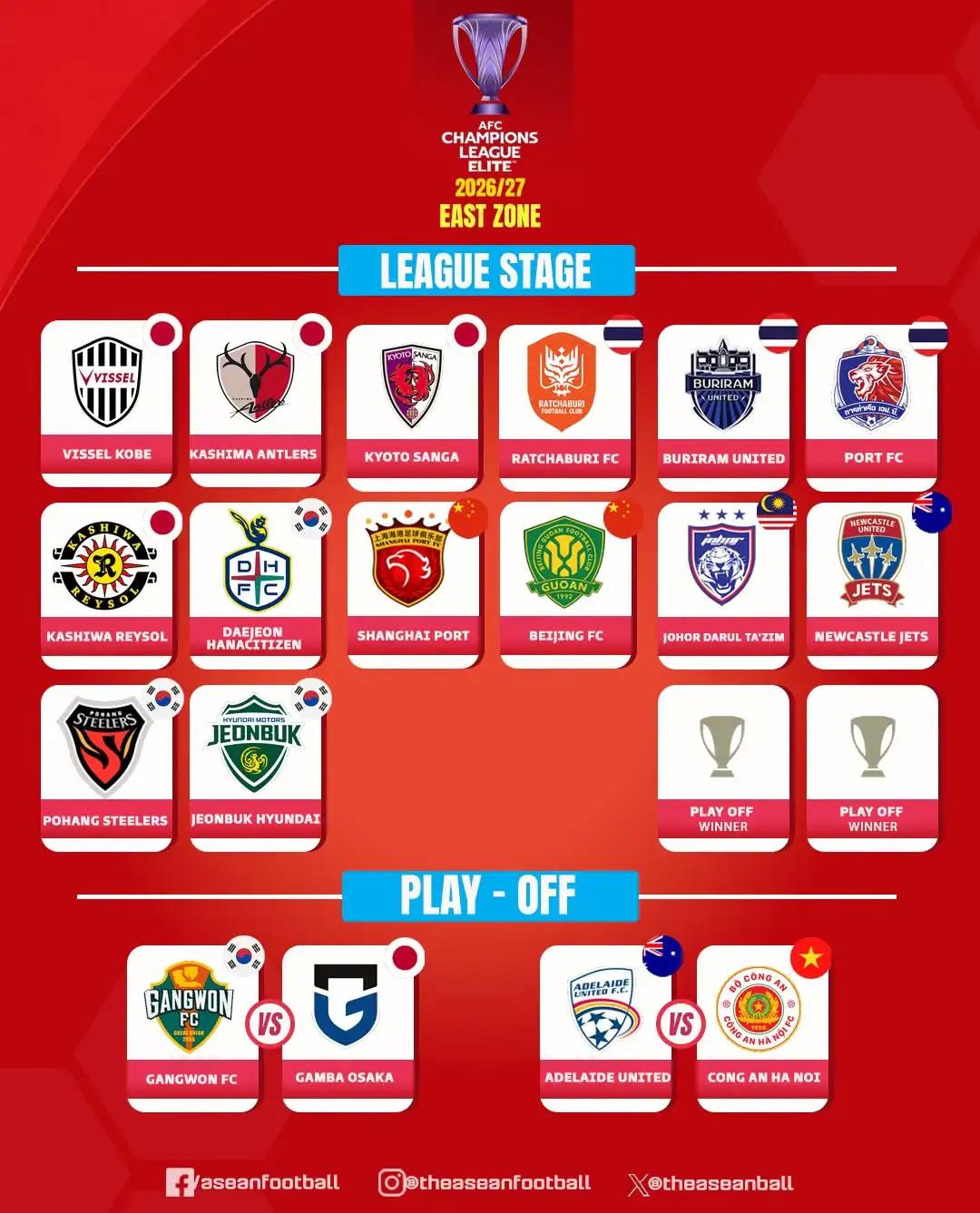
After the previous ACL season, the Thai League surpassed the CSL in points, earning three direct league-stage slots. The top three of last season's Thai League—Buriram United, Port FC, and Ratchaburi—will participate. Combined with CSL champions Port Shanghai, FA Cup winners Beijing Guoan, Australian A-League champions Newcastle Jets, and Malaysian Super League champions Johor DT, a total of 14 teams directly enter the league stage.
Four teams will compete in the playoffs: Gangwon, Gamba, Adelaide United, and last season's Vietnamese V-League champions Hanoi Police. On August 11, these four teams will play a single-elimination playoff to decide the two remaining league-stage spots.
Due to poor performances in the previous ACL, the CSL did not directly benefit from the expansion. However, the directly benefited leagues of Japan, South Korea, and Thailand each have relatively weaker teams among their qualifiers. Port Shanghai and Beijing Guoan may face Daejeon Hana Citizen (currently 9th in K1 League), who performed well last season but have struggled this year, as well as Kashiwa Reysol and Kyoto Sanga, who finished only 8th in their respective groups in the first half of the J1 League's "Centennial" season. Additionally, Port FC, last season's Thai League runners-up, only beat Xinpeng City 1-0 in a February friendly. Ratchaburi, last season's surprise Thai League team, lost 0-4 to Malaysian Super League side Selangor in a recent friendly. Both teams are clearly weaker than Thai League powerhouse Buriram United, so if the two CSL teams draw these opponents, their chances of winning increase.


Compared to the draw, the ACL format change has a greater impact on CSL teams. Previously, the ACL league stage draw divided the 12 teams in each zone into three pots, with the principle that teams from the same country would not face each other. Last season, the three CSL teams were in the same pot as A-League champions Melbourne City, meaning they would inevitably face all three Japanese and three Korean teams from the other pots, as well as the Thai and Malaysian champions, completing eight league-stage matches. The Japanese and Korean teams had collective strength advantages, while the Thai and Malaysian champions boasted foreign player advantages. Combined with CSL teams' lack of focus during the title race, their performances were disappointing.
In the new season, the ACL adopts a modified Swiss system. Teams are divided into four pots, and each team plays two matches against teams from each pot, completing eight rounds. Statistically, the chances of CSL teams avoiding strong Japanese and Korean sides have increased. Port Shanghai (Pot 1) and Beijing Guoan (Pot 3) are more likely to draw relatively weaker teams from the A-League, Thailand, Malaysia, or even the Vietnamese team that survives the playoffs.

Before the start of this ACL season, the Thai League leads the East zone standings with 62.846 points, well ahead of the CSL's 49.483 points by 13.363 points. Behind the CSL, the A-League (49.178 points) and Malaysian Super League (45.184 points) are closely pursuing. This season is crucial for the CSL's competition for future ACL slots. If they can seize the opportunities brought by the format reform and overtake the Thai League in points, it is entirely possible for the CSL to retain or even increase its participation quotas.
Port Shanghai and Beijing Guoan have both specifically brought in foreign players for the ACL during the summer transfer window, hoping to make an impact. After all, the CSL's ACL points last season (7.383 points) lagged far behind the A-League (17.667 points) and the Thai League (16.208 points). Since the CSL's historical points advantage will decrease significantly in the coming seasons, they must go all out starting this season to avoid the "shame" of being completely shut out of the ACL in the future.


Wonderfulshortvideo

vinicius junior transfer real madrid arsenal vini here we go arsenal news today real madrid news today ronaldo real madrid ronaldo edit



A sneak peak at yesterdays opener 👀

Think we might side with Francesca’s idea 😂

The highs & lows of racing 🐎

A different view to yesterday’s Stewards enquiry 👀

Perfectly explained by Francesca 🫶🏻

Keep an eye out for Adaay of Scarlett 👀
 Links
Links
 Contact
 App
App


