



Vietnam's national team at the 2026 ASEAN Cup lacks a true central midfielder.


The goalless stalemate with Singapore caused disappointment because of the ineffective forward line. But in truth, the biggest problem for Vietnam in the 2026 ASEAN Cup is situated in the middle of the park.
Vietnam's national team and the limitations of the Quang Hải - Hoàng Đức duo.
For the first time since the start of the 2026 ASEAN Cup, coach Kim Sang-sik's squad was overpowered by the opponent in what is considered the "heart" of their gameplay. With Quang Hải having a subdued performance, Hoàng Đức was nearly forced to carry the entire midfield against the pressure from Singapore's energetic midfielders.
The 7-0 victory over Timor-Leste in the opening match gave the impression that Vietnam had an almost perfect squad. However, that opponent was too weak to expose structural weaknesses. Singapore was different. The island nation's team, featuring players of Japanese (Kyoga Nakamura) and Korean (Song Ui Yong) heritage, played with high intensity, constant pressing, and rapid transitions. They didn't have more possession than Vietnam, but they made the hosts' midfield frequently appear inferior.
In this context, Quang Hải was almost neutralized. Every time he received the ball, the number 19 midfielder was immediately surrounded by two or three Singapore players, leaving no room for his creative passes or trademark turns. An under-par performance from Quang Hải quickly led to a significant decline in the connection between the midfield and the attack.
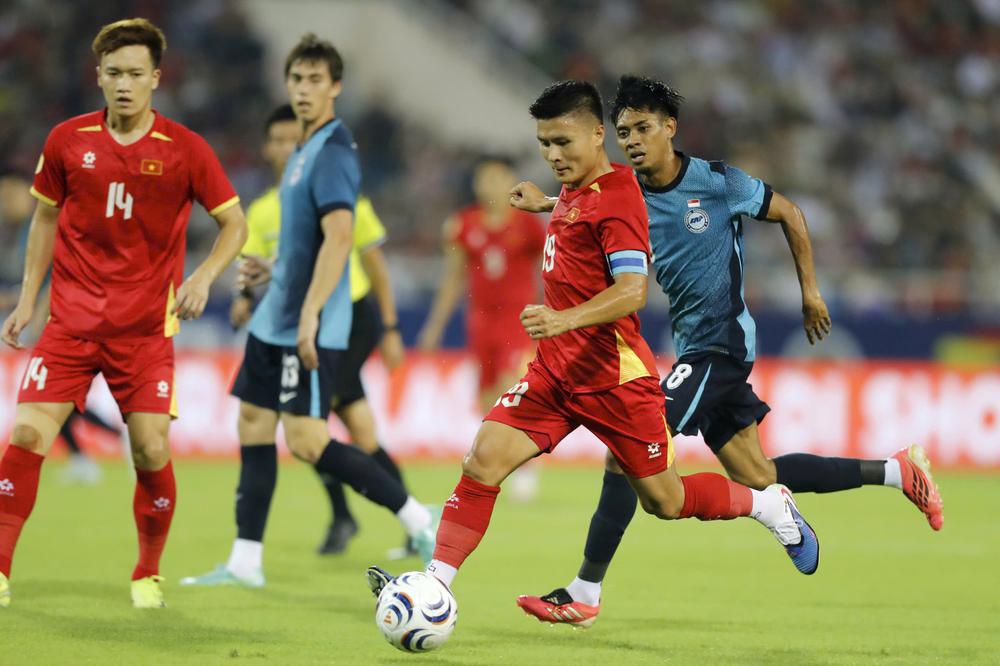
Both Quang Hải and Hoàng Đức are not true central midfielders, despite their unquestionable class. Photo by Hoàng Linh.
On the other hand, Hoàng Đức remained the most consistent player in midfield. He constantly dropped deep to receive the ball, escape pressing, control the tempo, and at times even had to engage in challenges to support the defense. But Hoàng Đức cannot do everything alone. He cannot simultaneously be the ball winner, playmaker, ball carrier, and appear in every hot spot. When Hoàng Đức was blocked, Xuân Son, Hoàng Hên, or Đình Bắc had to drop very deep to find the ball, significantly reducing the pressure on Singapore's defense.
In fact, this issue had appeared before the tournament. Looking at Vietnam's squad, coach Kim Sang-sik only has three true central midfielders: Hoàng Đức, Quang Hải, and Thành Long. However, Quang Hải is essentially an attacking midfielder, Hoàng Đức is more of a playmaker, and Thành Long has never been a priority choice in big matches. Names like Hai Long, Hoàng Hên, or Đình Bắc can drift inside, but they are essentially attacking players.
What Vietnam is lacking is a genuine defensive midfielder – a player willing to do the dirty work, tackle, intercept, recover the ball, and shield the defense. In other words, the team is missing a true "number 6" to share the burden with Hoàng Đức.
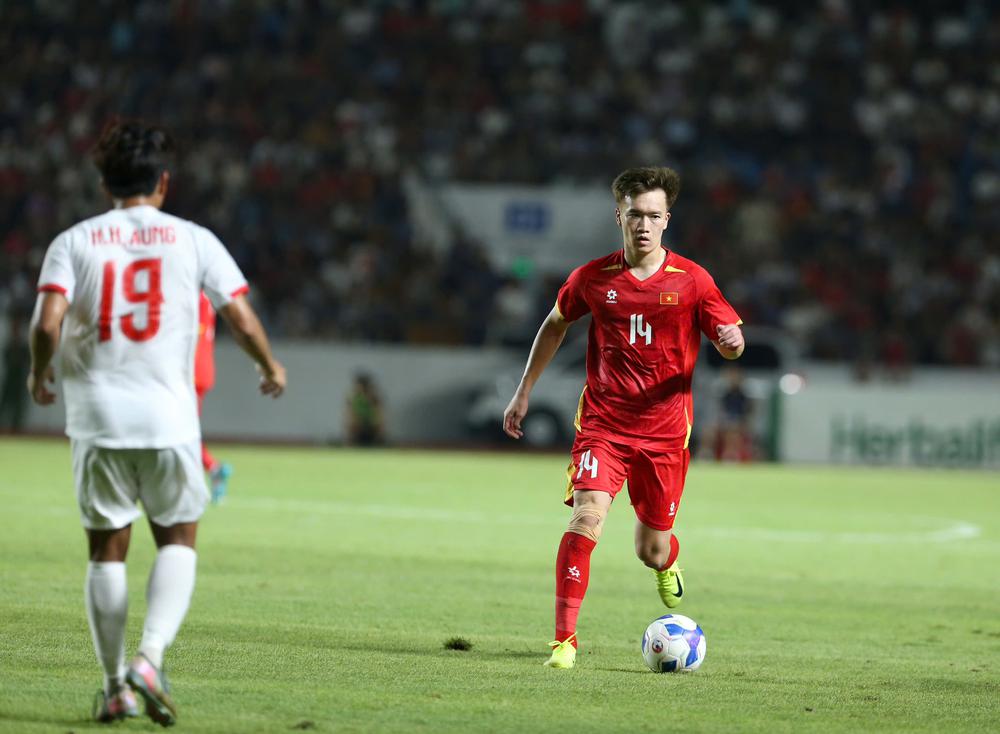
When Quang Hải's form drops, the weight falls entirely on Hoàng Đức's shoulders. Photo by Hoàng Linh.
This is not a new story for Vietnamese football. On the contrary, looking back at the most successful periods over the past two decades, the mark of an excellent holding midfielder is always present.
The 2008 AFF Cup had Nguyễn Minh Châu. He was not a star like Công Vinh or Minh Phương, but he was a true "sweeper" in coach Henrique Calisto's system, quietly breaking up play so that the forwards could create freely.
At the 2018 AFF Cup, coach Park Hang-seo built his midfield around Huy Hùng and Đức Huy. Neither was a football artist, but they possessed abundant stamina, fierce tackling ability, and excellent tactical discipline. This duo formed the shield that allowed Quang Hải to shine on the championship journey.
The same was true at the 2019 SEA Games. The presence of Đỗ Hùng Dũng in the U22 team brought absolute balance. His experience, ability to control the tempo, and ball recovery were the foundation for Vietnam's historic gold medal after 60 years of waiting.
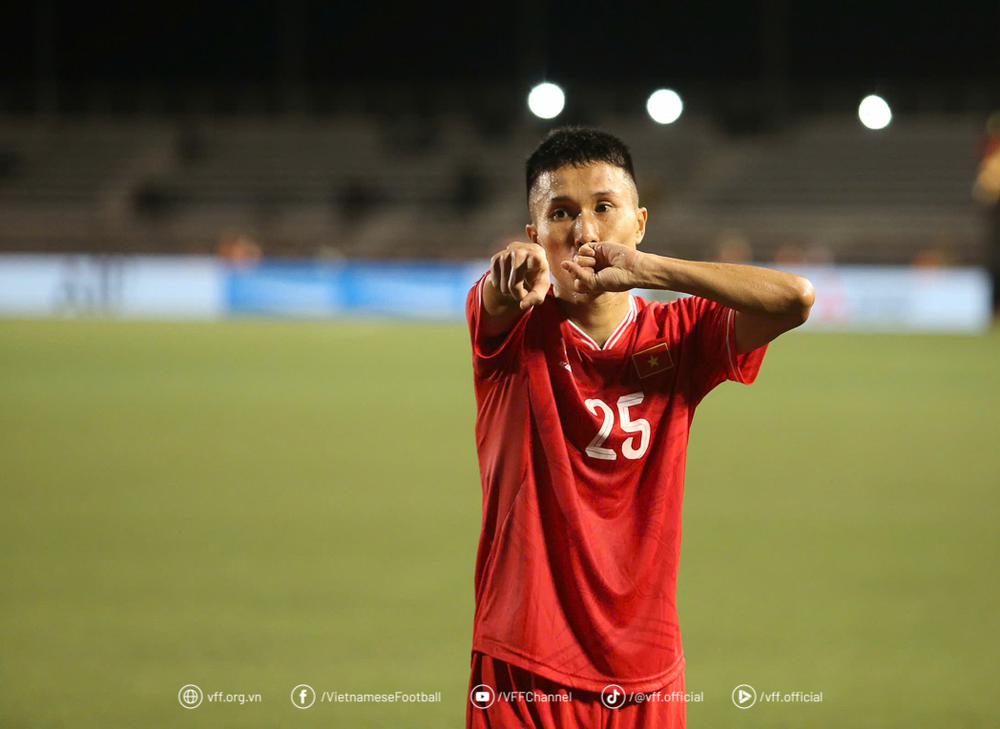
When facing strong opponents, Vietnam's team misses a player like Doãn Ngọc Tân. Photo by VFF.
Most recently, at the 2024 ASEAN Cup, Doãn Ngọc Tân was not the most famous player in the squad, but he was a crucial cog. His tackling, interceptions, and covering made the midfield solid, while freeing Hùng Dũng, Quang Hải, and other attackers from defensive responsibilities.
Therefore, the draw against Singapore is not merely a slip in results. It serves as a warning that Vietnam is returning to a long-standing weakness: lacking a true central midfielder. When facing opponents with strong, physical midfields, Hoàng Đức easily becomes isolated, and Quang Hải will continue to be suffocated without someone to share the workload.
Ahead lies Indonesia – a team with a quality midfield featuring many naturalized players of high class and superior physicality. If the midfield continues to be outmatched as it was against Singapore, Vietnam will face an even tougher test. Because in modern football, to control the game, you must first control the midfield. And right now, that is exactly where coach Kim Sang-sik is most troubled.


Wonderfulshortvideo
vinicius junior transfer real madrid arsenal vini here we go arsenal news today real madrid news today ronaldo real madrid ronaldo edit



A sneak peak at yesterdays opener 👀
Think we might side with Francesca’s idea 😂
The highs & lows of racing 🐎

A different view to yesterday’s Stewards enquiry 👀

Perfectly explained by Francesca 🫶🏻

Keep an eye out for Adaay of Scarlett 👀
 Links
Links
 Contact
 App
App


