



Indonesia's national team: Without a regional title, don't dream of the World Cup


Justin Hubner's mockery of Vietnam's triumph in a tournament "not recognized by FIFA" touched a raw nerve, exposing the greatest heartache of Indonesian football over three decades.
"You played well in a tournament that is not an official FIFA event. We'll meet again in official tournaments. Congratulations!" the Dutch-born star wrote on his X page. But if the ASEAN Cup is truly worthless, why has the archipelago nation yearned for that trophy for over 30 years? And if they haven't yet stood atop Southeast Asia, does Indonesia have enough foundation to talk about continental ambitions?
Three decades of searching for the missing trophy
Although the ASEAN Cup is not part of FIFA's official competition system, it has never been considered unimportant in Southeast Asia. For Indonesia, it is the trophy they desire the most.
Since the inaugural edition in 1996, Indonesia has reached the final six times, only to lose each time. They are known as the "perennial runners-up" of Southeast Asian football, watching Thailand, Singapore, Vietnam, and Malaysia all claim the title while they have nothing. If the ASEAN Cup didn't matter, the Indonesian Football Association (PSSI) wouldn't have poured resources into naturalization, hired high-profile coaches, and consistently aimed for the trophy every tournament.
It is entirely reasonable for Indonesia to aspire to continental prominence. In recent years, they have taken notable strides with a strong group of naturalized players, competing in the third round of the 2026 World Cup qualifiers and producing some encouraging outcomes against top teams. However, there remains a vast difference between improvement and genuine power.
It is impossible for any footballing country to bypass the regional arena and jump straight to continental elite status. Japan thrived in East Asia before winning the Asian Cup. South Korea has consistently been the top regional force. Even Australia, after joining the AFC, needed to prove itself in the Asian Cup before considering larger ambitions.
Indonesia is not an exception. In order to be a major Asian side, they first need to demonstrate that they are the top team in Southeast Asia. This is the natural progression of football. Hence, Justin Hubner's remarks only worsened the disappointment from the defeat to Vietnam and drew criticism from many Indonesian analysts. They said it is difficult to speak of "Asian level" when the national team has never even reached the top of the ASEAN Cup.
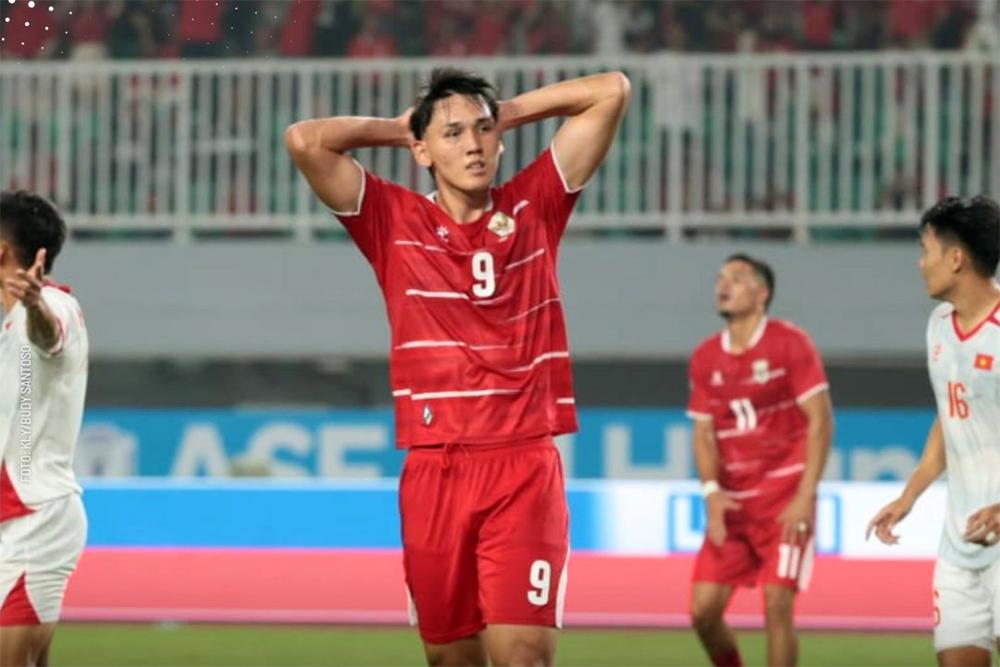
Mitchell Baker was utterly powerless facing the Vietnamese defense. Image: ASEAN United
After the loss to Vietnam, the mental pressure has become terrifying
Losing 0-3 to Vietnam at Pakansari not only stripped Indonesia of the Group A lead but also shattered the team's belief. They were outclassed in terms of structure, tactical discipline, and finishing. Indonesian press agreed that Vietnam was more composed, united, and mentally strong. On the other hand, Indonesia's defense showed many mistakes, particularly in the early stages.
News channels like CNN Indonesia, Bola Sport, and Suara noted that the home team was virtually overwhelmed by Vietnam's press. Goalkeeper Nadeo Argawinata, defenders Rizky Ridho, and Jordi Amat were heavily criticized for errors resulting in conceded goals. A large number of supporters also went to Nadeo's personal page to insult him, and coach John Herdman along with the players were jeered on the field after the match ended.
What is more concerning is the mental trauma now affecting the whole squad. Head of delegation Sumardji openly stated his hope that the players would regain their morale soon for the decisive game against Singapore. CNN Indonesia reported that after the defeat to Vietnam, the team's mood has turned gloomy, missing the earlier smiles and relaxation.
Actually, this stress stems from overly high expectations. Over the past few months, Indonesian football was celebrated as an emerging power in Asia. However, the ASEAN Cup tells a different tale. Confronted by a Vietnam that is experienced, structured, and possesses the resolve of the reigning champion, Indonesia was brought down to earth, realizing they still have much to accomplish.
The pressure is now even more intense, as Indonesia's sole route to the semifinals is to defeat Singapore at Jalan Besar. Any draw or defeat would end their ASEAN Cup 2026 journey in the group stage, prolonging the trophy drought beyond 30 years. Maybe that's why Justin Hubner's sarcastic comment backfired. Rather than devaluing Vietnam's win, it only made fans recall that Indonesia still lacks a single Southeast Asian title to support their bigger ambitions.


Wonderfulshortvideo

vinicius junior transfer real madrid arsenal vini here we go arsenal news today real madrid news today ronaldo real madrid ronaldo edit



A sneak peak at yesterdays opener 👀

Think we might side with Francesca’s idea 😂

The highs & lows of racing 🐎

A different view to yesterday’s Stewards enquiry 👀

Perfectly explained by Francesca 🫶🏻

Keep an eye out for Adaay of Scarlett 👀
 Links
Links
 Contact
 App
App


