



Coach Kim Sang Sik and His Silent Overhaul


Moving from a draw to a win involves two contrasting perspectives, and it's not merely a matter of feelings. Against Singapore, the team took a "big-spender" approach, yet the outcome was far from encouraging. In contrast, with a more rational "capital distribution," Coach Kim Sang Sik achieved a perfect "investment deal" in the victory over Indonesia. From the perspective of a title contender, the way the Korean manager utilized his squad is more remarkable than a win that was essentially mandatory.
The absence of Nguyen Quang Hai and Doan Van Hau from the starting lineup of the Vietnam national team reflects a reality: the generation of U23 players from Changzhou 2018 is no longer indispensable. Of course, they are still there, still possessing quality, but they now exist in a different context—merely options among many others, rather than the default architects of the national team's structure.
Honestly, for many years, Vietnamese football seemed trapped in nostalgia for the 2018 golden generation. The collapse of the "Troussier dynasty" only reinforced that. It wasn't until Xuan Son emerged and made a difference at the 2024 ASEAN Cup that the seeds of a national team overhaul were truly planted by Coach Kim Sang Sik.
The reality on the Pakansari pitch was the culmination of a process—or more precisely, a strategic direction regarding personnel by the Korean coach. Apart from Nguyen Tai Loc, the only naturalized player in the starting eleven, the other ten were all pure domestic products at their career peak. It was the first time Kim Sang Sik unveiled a lineup nearly entirely detached from the shadow of 2018, featuring players like Viet Anh, Thanh Long, and Van Vi—footballers who matured in a different, harsher, and more competitive domestic environment. By discarding the "pressure of reputation" to trust new faces, Kim truly solved the puzzle that his predecessors often feared.
The story of the Vietnam national team at Pakansari cannot be separated from that of the U23 Vietnam team, which was gathering at the same time. There, players like Cao Van Binh, Thanh Trung, Phi Hoang, and Thanh Nhan have each played around 20 matches in the 2025/2026 V-League, directly facing foreign imports and veterans every week.
This is the core difference from the previous generation: Today's U23 players are not "promoted" from other youth teams but still undergo the "V-League filter." That is the essence of the silent restructuring that Coach Kim Sang Sik has created: U23 players are not automatically formed and do not have an inherent place in the senior team. The separation between the two team levels has never been so clear.
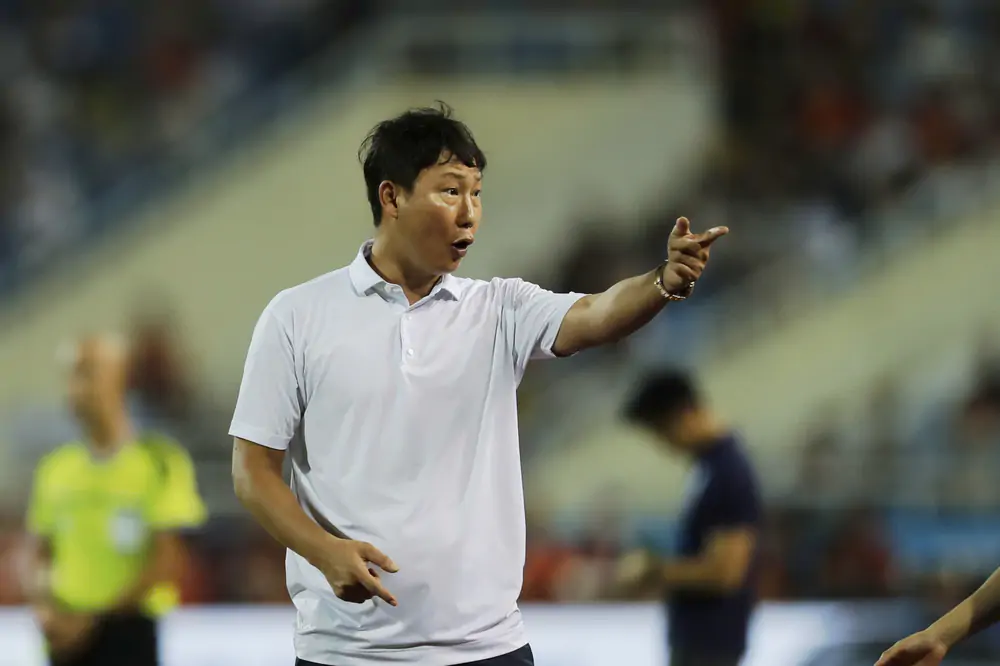
Coach Kim Sang Sik has truly built a completely new Vietnam national team compared to his predecessors. Photo: Hoang Linh
Coach Kim Sang Sik's priority: versatility. A full-back who can push forward like a winger, a central midfielder ready to drop deep and cover like a center-back. This flexibility fosters a tactical mindset that allows the team to reach a higher level of play: disciplined, pragmatic, and highly calculated.
That is why Nguyen Dinh Bac was still selected despite not succeeding in the match against Singapore. Kim trusts Dinh Bac not because he is a U23 star, but because of the adaptability of a striker who has been forged in the V-League since the age of 19.
The biggest difference between Vietnam and the rest of Southeast Asia lies in how resources are optimized. While rivals like Indonesia or Malaysia are "floundering" in massive naturalization experiments, Kim continues to follow the "orthodox" path by using the "filter" of the national league.
That alone constitutes a "revolution" for Vietnamese football, which has long been overly dependent on regional achievements at various team levels.
Solving the personnel puzzle is only a necessary condition. The harder challenge lies ahead: how to make a rejuvenated squad with diverse origins—from pure V-League products to naturalized players—reach the regional and continental peak convincingly, both in terms of personnel and playing style.
This is not just Coach Kim Sang Sik's challenge. It is the challenge of an entire footballing nation, and of the fans themselves, who need to learn to trust a lineup without the most familiar names, in order to embrace a Vietnam national team that is truly undergoing a transformation.
As we have seen, it may take a hundred years to produce a Changzhou 2018 generation, but even so, nothing is immutable. Being ready to change is what truly matters.


Wonderfulshortvideo
vinicius junior transfer real madrid arsenal vini here we go arsenal news today real madrid news today ronaldo real madrid ronaldo edit



A sneak peak at yesterdays opener 👀

Think we might side with Francesca’s idea 😂

The highs & lows of racing 🐎

A different view to yesterday’s Stewards enquiry 👀

Perfectly explained by Francesca 🫶🏻

Keep an eye out for Adaay of Scarlett 👀
 Links
Links
 Contact
 App
App


