



AC Milan: Time is not endless, Amorim!



Following three early-season friendlies, Ruben Amorim's Milan has displayed a new image, yet it has also exposed plenty of the same old shortcomings. At this point, two weeks away from the start of the season, Milan has not demonstrated preparedness.
If we only look at the training results, no serious conclusions can be drawn about Milan. They won 7-0 in an internal match against the youth team, drew 2-2 at Celtic, drew 1-1 against Inter, and then lost 0-3 to Chelsea in a match where Amorim continued to rotate the squad for experimentation. Those scores do not accurately reflect Milan's quality, especially since this is a period where the Portuguese coach is still trying to answer his most important question: Who truly fits the new project?
Milan of Amorim
Amorim's imprint has begun to appear. Milan is required to play more proactively, press higher, maintain a compact formation, and most importantly, move the ball forward instead of the slow, predictable sideways passing seen under Max Allegri. They defended well against Inter, at times preventing the opponent from building attacks, while the forward line prioritized quick play, making decisions within three or four passes.
The reality on the pitch shows a significant gap between ideas and execution, especially against a much stronger opponent like Chelsea. The Rossoneri had no shots on target and were dominated for most of the match. Nevertheless, the 0-3 loss (which could have been worse if Chelsea hadn't hit the woodwork twice) should not be considered a disaster. Milan conceded the first goal in stoppage time of the first half and two more early in the second half, right after they made eight substitutions and the lineup was disjointed while the opponent had achieved greater cohesion and stability.
It must also be noted that Milan spent over 100 million euros to bring in two notable new signings: striker Goncalo Ramos and center-back Mario Gila. However, Ramos joined late after the World Cup break and is still regaining fitness, while Gila suffered an injury in his debut and has not yet returned to play. Christian Pulisic, Santi Gimenez, and Mike Maignan have yet to reappear after the 2026 World Cup, so Milan's preparation process has faced many difficulties.
It is too early to conclude that Amorim is failing, but the fact that Milan has failed to create pressure, lacks confidence in building play, lacks clear attacking ideas, and is slow to start, making them vulnerable to conceding early, remains a worrying sign.
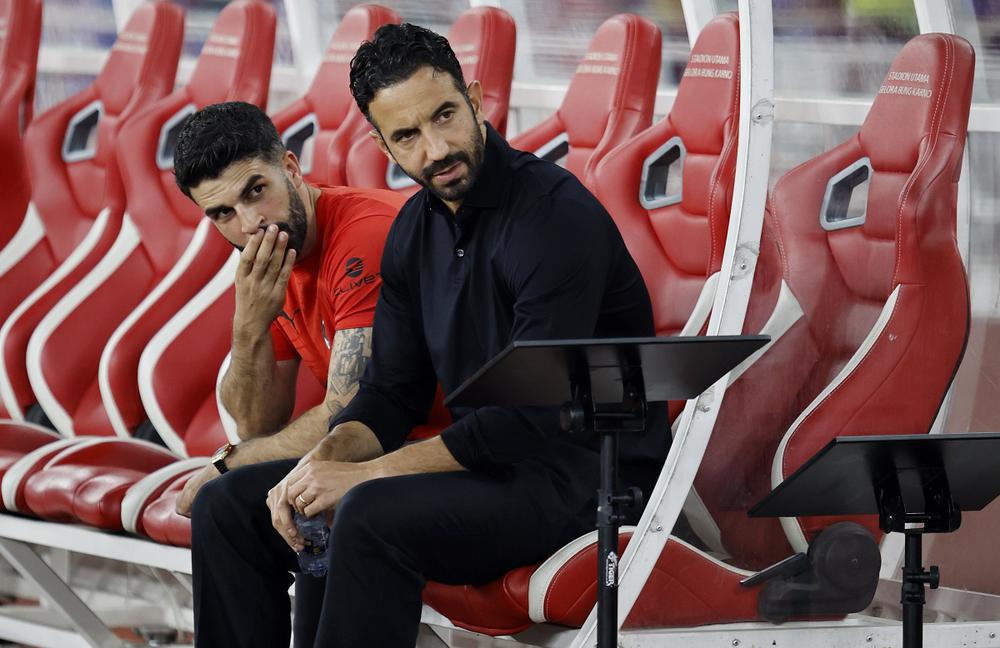
Milan is patient, but they also need Amorim to be more decisive with his plan.
Amorim needs to be more decisive.
As the new season approaches, Milan is the only major club that has not yet sold or loaned out any player. Amorim has spent too much time evaluating and assessing players. Even those who are expected to leave sooner or later (Fikayo Tomori, Pervis Estupinan, David Odogu, Youssouf Fofana, Filippo Terracciano, Ruben Loftus-Cheek, Rafael Leao, Santi Gimenez, and Samuel Ricci) are still being closely scrutinized in friendlies, and this has affected the squad overhaul.
Time is running out. The match against Chelsea was one of the last opportunities for experimentation, and now Milan only has the friendly against Manchester United (August 15) before officially starting the Serie A season against Torino on August 22. This week, Amorim must make decisions on who to keep, who to let go, and who to buy. Milan's transfer activity has been stagnant for nearly a month, causing them to miss several good opportunities in the market, seeing targets like Kerim Alajbegovic (to Juventus) and Konstantinos Karetsas (to Dortmund) find new clubs.
Patience does not mean hesitation.
There is a truth that Milan must accept: Amorim did not come to Italy to please anyone who does not share his vision. Milan's choice of Amorim means they must accept his football philosophy, formation, and somewhat extreme working methods. And they must be extremely patient with their choice. Amorim did not come to fix things; he came to build anew. Until the task of creating a team in his own image is complete, he is ready to leave in failure rather than go against his principles for temporary success.
Those statements from Amorim's time at Old Trafford come back to mind. Despite losing heavily 0-3 to Chelsea, he still insisted the team is on the right track and emphasized that this is a preparation process for Milan to be ready for the season, though he admitted Milan still has "a lot of work to do," especially in ball handling.
But patience does not equal hesitation. Milan can give Amorim time, but not endless time. It is time for the Portuguese coach to provide an answer about what he will do with what he has. Who to sell, who to loan, who to buy—these are decisions that are crucial not only for Milan's future but also for his own.


Wonderfulshortvideo
vinicius junior transfer real madrid arsenal vini here we go arsenal news today real madrid news today ronaldo real madrid ronaldo edit


A sneak peak at yesterdays opener 👀
Think we might side with Francesca’s idea 😂

The highs & lows of racing 🐎
A different view to yesterday’s Stewards enquiry 👀

Perfectly explained by Francesca 🫶🏻

Keep an eye out for Adaay of Scarlett 👀
 Links
Links
 Contact
 App
App


