



ASEAN Cup 2026 before the semifinals: The same old script for Southeast Asian football



With the group stage of the 2026 ASEAN Cup over, the regional football landscape appears to have been "filtered," returning to its traditional hierarchies. For the first time ever, every past champion is present in the semifinals, leaving Indonesia yet again failing to reach regional glory—a fact that only strengthens their resolve to pursue what they call "escaping the local pond."
Vietnam, Thailand, Malaysia, and Singapore—this powerful quartet not only represents the strongest teams of the moment but also brings together a total of 15 championship titles from throughout the tournament's history. The complete presence of all "kings" turns the semifinals into a grand celebration of traditional values, yet it also exposes a harsh reality: the stagnation of football in the "lower tier" region.
Looking back, nearly two decades ago in 2007, these same four names were also on the stage of the top four. However, back then, Vietnam and Malaysia were still mere pursuers, hungry for their first titles. Now, after Malaysia has won one and Vietnam has even claimed three championships, this reunion carries the flavor of an "elite club," where experience and old-school grit reign supreme, leaving no room for "dark horses" or fresh breezes.
Therefore, even though Thailand shows little enthusiasm, the other semifinalists still have plenty of reasons to fight. But if the ASEAN Cup still holds value, the thought-provoking question is not who will win, but why, for nearly two decades, the power map of Southeast Asian football has barely shifted.
The answer lies in the absent names. Indonesia, a six-time runner-up in this tournament, is believed to now have a stronger pool of talent than before, boasting a wealth of Dutch-born naturalized players—enough to field two different squads with arrogance. Yet, for the second consecutive time, they have been eliminated in the group stage.
This is not an isolated failure, but the result of a team-building philosophy lacking a solid foundation: relying on hastily naturalized players from lower European leagues, rather than developing a consistent playing identity from the academy to the national team.
The Philippines followed a similar path and met a similar fate. Once hailed for their naturalization strategy since the 2010s, the island nation remains stuck in the middle of the regional rankings, unable to produce a domestic generation capable of competing once the American- and British-born players of Filipino descent fade away.
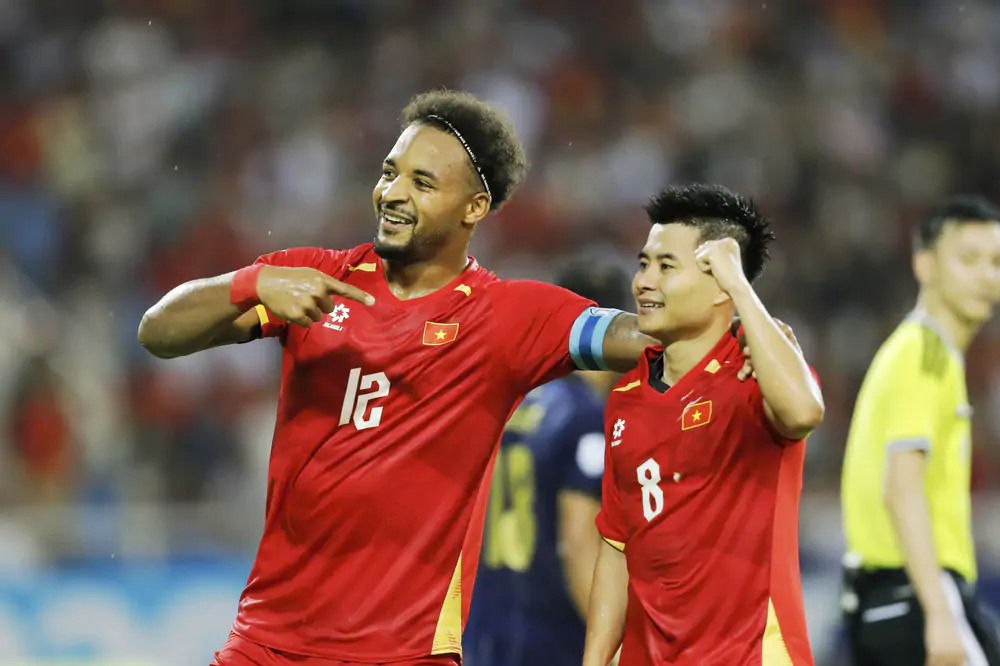
Vietnam also uses naturalized foreign players, but its core remains locally trained domestic players like Thanh Long (right). Photo: Hoang Linh
In contrast, the four semifinalists have taken different approaches. Thailand builds its strength on a deep domestic league and a possession-based playing style shaped over multiple coaching generations. Vietnam, despite also using players of foreign origin, maintains a stable domestic backbone and a player like Dinh Bac, nurtured from the domestic system and currently leading the scoring charts.
Singapore, despite having far more limited resources, compensates with organization: the team of young local coach Gavin Lee went through the group stage unbeaten, drawing with both Vietnam and Indonesia, before securing a semifinal spot for the second consecutive time—a feat built on tactical discipline rather than individual stars. Even Malaysia, though missing a host of key players and entering the semifinals with a squad considered much weaker than when they lost 1-3 to Vietnam last March, still managed to earn nine points in the group stage thanks to a tactical framework that has existed long enough to withstand absences.
This reveals a harsh rule: in a region where the gap with the continental level remains wide, what determines status is not budget or the number of naturalized players, but the continuity of a football system—from youth development and domestic leagues to the coaching philosophy of the national team. The four former champions continue to dominate not because they are absolutely stronger, but because they have not let that foundation break.
But looking beyond the semifinal milestone, the picture is not entirely encouraging for Southeast Asian football. The fact that all four old names continue to dominate also means that, after all these years, the region has yet to produce a new force capable of breaking the familiar cycle. No genuine "phenomenon" has emerged to challenge the old order through its own internal strength, rather than through short-term naturalization gambles.
A semifinal lineup of all champions may be a sign of stability, but it could also be a warning of stagnation. When the line between the two is still thin, Southeast Asian football can only hope that these "fateful" semifinal clashes will prove that it is truly moving forward…


Wonderfulshortvideo

vinicius junior transfer real madrid arsenal vini here we go arsenal news today real madrid news today ronaldo real madrid ronaldo edit



A sneak peak at yesterdays opener 👀

Think we might side with Francesca’s idea 😂

The highs & lows of racing 🐎

A different view to yesterday’s Stewards enquiry 👀

Perfectly explained by Francesca 🫶🏻

Keep an eye out for Adaay of Scarlett 👀
 Links
Links
 Contact
 App
App


