



Why is the Vietnam national team struggling at home but thriving away in the 2026 ASEAN Cup?



The Vietnamese national team is presenting a curious contradiction in the 2026 ASEAN Cup. Based solely on the outcomes, many could conclude that Kim Sang Sik's side is more effective when playing away.
However, when analyzed more deeply, the issue seems to be not about the venue but rather stems from psychological factors and the team's approach to each match.
After four group stage matches, the difference in Vietnam's performances is very clear. On the road, the red-shirted team defeated Timor-Leste 7-0 and Indonesia 3-0. These two victories yielded a total of 10 goals while keeping clean sheets.
In stark contrast, the two home matches were much more difficult. Vietnam was held to a 0-0 draw by Singapore before struggling to beat Cambodia 3-1, where the turning point came only from an own goal by the opponent late in the game.
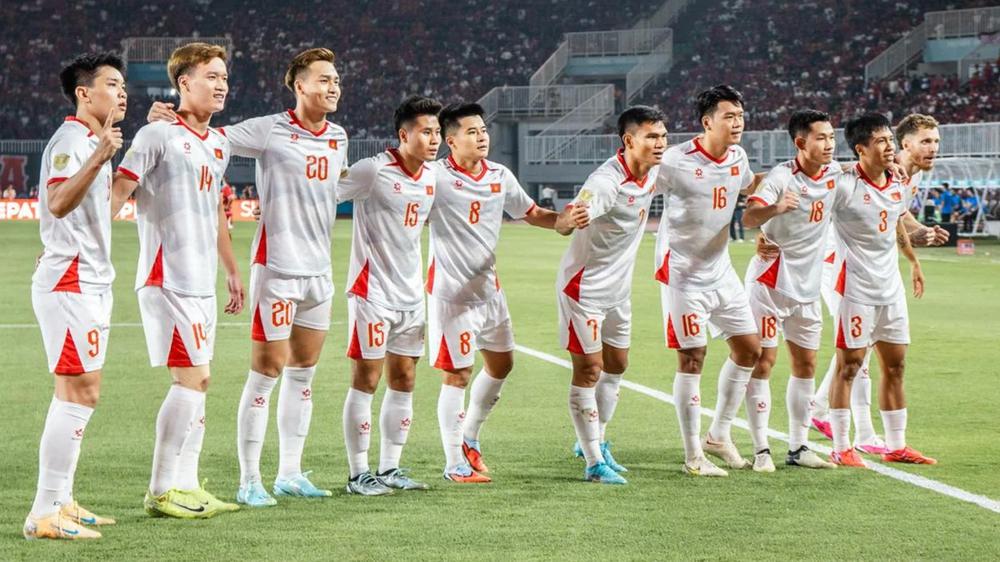
Vietnam has secured a spot in the semifinals of the 2026 ASEAN Cup. Photo: ASEAN United
This contrast makes many wonder whether Vietnam actually plays better away from home. In reality, the answer likely lies in the mental state the players bring onto the pitch. When facing Indonesia away, Vietnam entered the match with high concentration. This opponent was considered one of the top contenders for the championship, possessing many quality players and always creating great pressure at home. In that situation, the Vietnamese players had no reason to be careless or lose vigilance.
That mindset helped the team play with great decisiveness. Every counterattack opportunity was maximized, and the spaces behind Indonesia's defense were constantly exploited. Notably, the expected goals (xG) statistics show that Vietnam only created about 1.15 xG but scored three goals. This figure reflects extremely efficient chance conversion, far exceeding normal expectations.
In contrast, the draw with Singapore tells a completely different story. Vietnam created more chances, with an xG of around 1.8, but ultimately could not score a single goal. This shows that the problem is not about creating opportunities but converting them into goals. When concentration drops or the competitive mindset is not at its peak, even the clearest chances can be missed.
A similar scenario repeated against Cambodia. Vietnam still dominated possession, attacked proactively, and applied constant pressure. However, the team faced many difficulties in finishing the game. If not for the opponent's own goal at a crucial moment, Vietnam would likely have had to accept another disappointing result at home. Only after that knot was untied did the match become easier, and Đình Bắc completed a brace to seal the 3-1 victory.

Photo: Hoàng Linh
So why does the same team show two such different faces? The answer lies in status and psychological pressure. After the devastating 7-0 win over Timor-Leste, Vietnam entered the match against Singapore as the overwhelming favorite. The opponent deliberately sat deep, surrendered possession, and waited for mistakes. In that context, the feeling that "goals will come" easily arises. Just a slight loss of sharpness or focus in decisive moments, and the team pays the price with missed opportunities.
This shows that Vietnam's paradox is not simply about home or away. The team seems to play better when they clearly feel the pressure and understand that even a small mistake could cost them. Indonesia created that feeling, while Singapore and Cambodia did not.
This is also a problem that many big teams often face. When facing opponents of equal or greater strength, concentration is always at its maximum. But when facing lower-rated teams, the challenge lies in breaking down massed defenses, maintaining patience, and keeping a steady intensity for the full 90 minutes. That is no easy task for any team.
The psychological signs were also quite evident in each line. The defense, which had been solid and confident against Indonesia, had moments of lapses when facing Cambodia. The midfield, which had completely controlled the center against Indonesia's quality midfielders, could no longer maintain the same dominance in subsequent matches. What Vietnam lacks at the moment is consistency and the ability to maintain focus in all situations.
Looking ahead, the semifinal against Malaysia will be the biggest test of character for coach Kim Sang-sik's team. In theory, Vietnam has plenty of reasons to be confident, having beaten Malaysia 3-1 in the Asian Cup qualifiers and just completed a fairly convincing group stage. Meanwhile, the opponent has faced many squad difficulties and had a less impressive path through the group stage.
However, these very factors could become a dangerous trap. Southeast Asian football history has witnessed many shocks stemming from complacency. Vietnamese fans surely still remember the 2014 AFF Cup semifinal, when the team held a big advantage after the first leg but ultimately fell bitterly at home.


Wonderfulshortvideo

vinicius junior transfer real madrid arsenal vini here we go arsenal news today real madrid news today ronaldo real madrid ronaldo edit



A sneak peak at yesterdays opener 👀

Think we might side with Francesca’s idea 😂

The highs & lows of racing 🐎

A different view to yesterday’s Stewards enquiry 👀

Perfectly explained by Francesca 🫶🏻

Keep an eye out for Adaay of Scarlett 👀
 Links
Links
 Contact
 App
App


