



Vietnam's national team and the gaps that need to be filled



Vietnam's national team went through the group stage of the 2026 ASEAN Cup without a loss, yet their defensive setup has shown multiple weaknesses, compelling coach Kim Sang Sik to quickly refine it ahead of the semi-finals.
Vietnam's national team concluded their group stage campaign at the 2026 ASEAN Cup with impressive statistics. Coach Kim Sang Sik's side topped Group A with 10 points from four matches, scoring 13 goals and conceding only once. However, behind that flawless facade, the team faced difficult moments against Singapore and Cambodia, even at home in My Dinh Stadium. During those matches, the defensive system exposed worrying gaps.
Observing Vietnam's style of play, it is evident that coach Kim Sang Sik has built a more proactive defensive system: Instead of dropping deep, the team pushes high to apply pressure, constantly marking opponents, maintaining a compact formation with close distances between lines to "smother" the opponent's build-up play and passing. The defense, consisting of three center-backs combined with two wingbacks who move up and down in sync, has formed a solid wall, helping Vietnam achieve success in recent years.
However, football is never just about dry statistics, and this defensive system has often exposed alarming gaps. Looking back at the group stage, Vietnam's defense has repeatedly put itself in difficult positions due to individual carelessness. If these gaps in the defense are not quickly sealed, the ambition to claim the title will face a major risk in the semi-finals against the challenge of Malaysia.
In many situations, Vietnam's backline has consistently been caught off guard by careless handling. Instability has appeared among several key players. For instance, Xuan Manh has had several unsafe plays on the wing, with weak back passes that put Nguyen Thanh Chung in difficult positions and directly allowed opposing forwards to steal the ball near the penalty area.
Moreover, Thanh Chung has been hesitant when building play from the back. Even goalkeeper Le Giang Patrik has occasionally failed to hold onto the ball after long-range shots from opponents. Such incidents have warned of a lack of concentration and coordination in the defensive line.
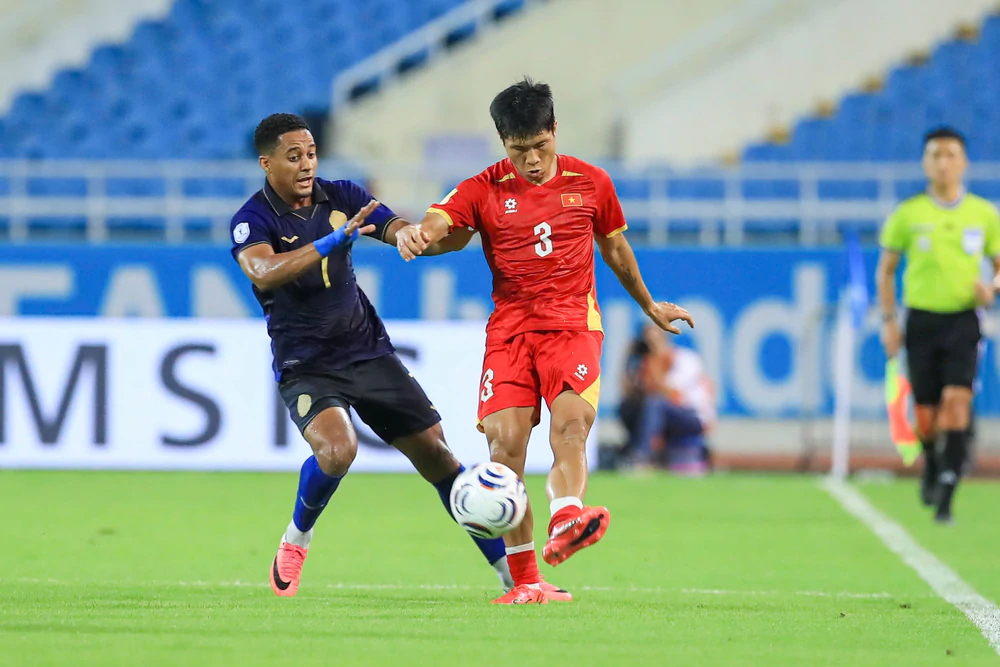
Vietnam's national team will need to pay more attention to avoid exposing gaps in their defense. Photo: Hoang Linh
Beyond individual errors, Vietnam's team shape faces a major challenge in countering rapid transitions. Opponents have consistently exploited the space behind the center-backs. The slow covering forced goalkeeper Le Giang Patrik to repeatedly rush out of the box to act as a sweeper.
In the semi-finals, Malaysia is expected to apply much more intense pressure than in the group stage. Malaysia possesses a pragmatic playing style, strong physicality, and the ability to ruthlessly punish opponents' mistakes. While Vietnam's center-backs hesitate between stepping up to intercept or holding their positions, the midfielders are slack in closing down opponents. The large space in front of the penalty area will be a dangerous zone that Vietnam must cover thoroughly, or risk being exploited by Malaysia. Malaysia's forwards have superior speed and technique, capable of capitalizing on any lapse in Vietnam's defense.
It is likely that Malaysia will fully exploit direct attacks, confronting the three center-backs head-on, as well as shots from outside the box. Vietnam needs to carefully devise a plan to block these threats and patch up the gaps in midfield.
Therefore, the midfielders must work hard to track back and provide solid defensive support, acting as a quality "anchor" to break up plays. At the same time, they must protect the second line, actively shield and apply pressure to prevent opponents from having free shots from distance. This will be the appropriate approach for Vietnam to counter the opponent's attacking schemes.
In the knockout stage, there is no room for error. Re-establishing tactical discipline in the defense is a top priority for coach Kim Sang Sik and his players if they aim to conquer the regional title.


Wonderfulshortvideo

vinicius junior transfer real madrid arsenal vini here we go arsenal news today real madrid news today ronaldo real madrid ronaldo edit



A sneak peak at yesterdays opener 👀

Think we might side with Francesca’s idea 😂

The highs & lows of racing 🐎

A different view to yesterday’s Stewards enquiry 👀

Perfectly explained by Francesca 🫶🏻

Keep an eye out for Adaay of Scarlett 👀
 Links
Links
 Contact
 App
App


