



Vietnam vs Malaysia: The Puzzle of Coach Kim Sang Sik



Vietnam's advancement to the semifinals is certainly not a surprise, but unlike the campaign nearly two years ago, which evolved from instability to smoothness and sharpness, in the ASEAN Cup 2026, the performance chart of Coach Kim Sang Sik's players has been a series of ups and downs in their pursuit of victory.
From a 7-0 victory with 5 goals in the first 45 minutes, to dozens of shots without scoring against Singapore, then needing only 15 minutes to score 2 goals from the first two shots on goal in Indonesia. And just days later, the struggles and difficulties in putting the ball into the opponent's net resurfaced in the win over Cambodia.
These contrasting images within the same ASEAN Cup 2026 are not coincidental. They are traces of a puzzle that Coach Kim Sang Sik has yet to fully solve: how to make the Vietnam team play well, even when no one is putting pressure on them.
Looking at the numbers, the paradox becomes clearer. Against Indonesia, Vietnam created only about 1.15 expected goals (xG) but scored three goals - a performance far exceeding the average. Against Singapore, the xG reached 1.8, significantly higher, but Kim's team could not break through a defense that chose to drop deep, concede possession, and give up ground.
The 3-1 win over Cambodia also had a similar flavor: Vietnam held 75% possession, pressed intensely on the opponent's half, but until the own goal late in the game, the deadlock remained unbroken.
Leaving aside the match against Timor-Leste, which lacked sufficient data for analysis due to the opponent's inability to cause damage, in the other three games, a common pattern emerged: Vietnam is strongest when placed in a counter-attacking situation or when forced into a corner, and weakest when it has to break down a crowded, patient defensive block on its own.
Simply put, we often play convincingly in the role of the underdog, when the chances of winning are minimal. Conversely, when victory is almost within grasp, the Vietnam team still finds a way to make things difficult for themselves.
This is not a new phenomenon, although we cannot yet determine whether it is a "weakness" or a "trait" in terms of professional aspects. Vietnamese football once underwent a painful experiment to find a cure for this.
Under Coach Philippe Troussier, the team was required to abandon their defensive-counterattacking instincts to build a proactive possession-based game from the back, approaching the philosophy of developed football nations. The result was a series of heavy defeats, widespread skepticism in public opinion, and ultimately the departure of the French coach himself.
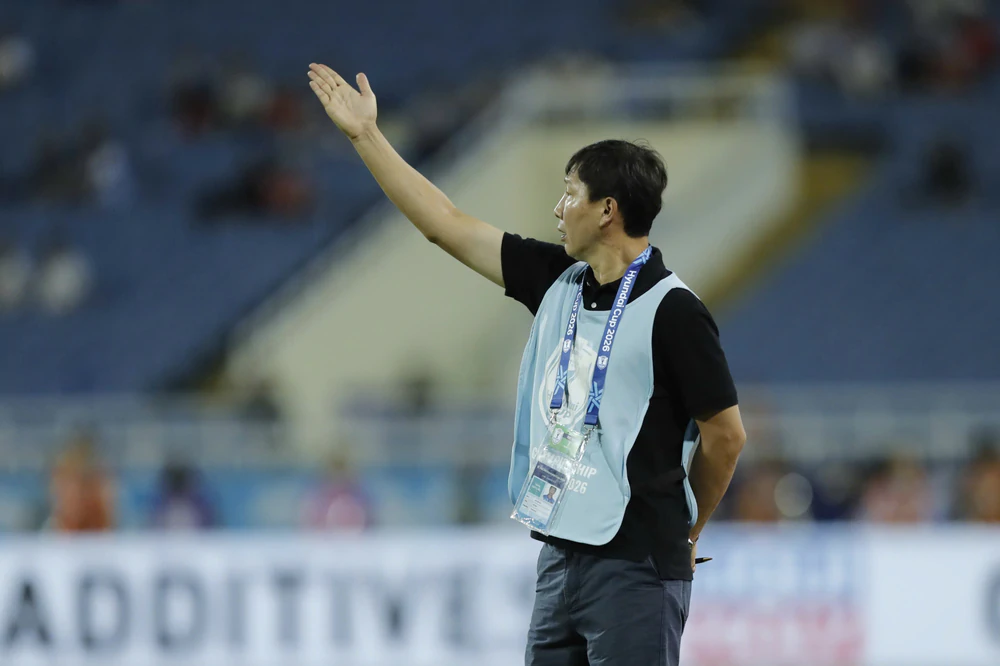
Vietnam's team under Coach Kim Sang Sik has yet to demonstrate dominant form when playing against weaker opponents. Photo: Hoang Linh
The lesson learned is not "don't attack," but rather the thin line between tactical ambition and execution capacity. Kim Sang Sik, the successor, chose a more cautious approach: retaining the solid defensive identity and sharp counter-attacks as a foundational weapon. But this very caution means the old puzzle has never really been solved, merely set aside.
The issue becomes more controversial because this time, Coach Kim has at his disposal the best attacking squad Vietnamese football has ever had. Nearly all the problems in the attack have been addressed simultaneously: three naturalized players and a young striker have confirmed their class. Not to mention the attacking midfield duo of Hoang Duc and Quang Hai.
It can be said that rarely has Vietnam's attacking line been so diverse and rich in quality. So it would be hard to make excuses if they cannot solve the problem of scoring when facing low-block defensive teams.
A good set of forwards only fully realizes their value when the system behind them creates space for them, and that is the bottleneck. When opponents actively pack the defense, space disappears, the final passes become monotonous, and the best strikers can only wait for a personal moment of brilliance, rather than being operated by an organized attacking mechanism.
The real test will come in the semifinal round, starting with an away trip to Malaysia. Malaysia's coach Tan Cheng Hoe is very familiar with Vietnamese football, and the "example" of Singapore is still fresh. This is the time for Coach Kim Sang Sik to demonstrate the problem-solving values he once brought to the Vietnam U23 team.
We don't need another good striker, but rather to diversify the methods of attack: sharpening set pieces, encouraging long-range shots when the middle is blocked, and speeding up ball circulation to the flanks to stretch the opponent's defensive block instead of confronting it directly. Equally important is the psychological aspect: the team needs to learn to create pressure on themselves, rather than only responding well when backed into a corner.


Wonderfulshortvideo

vinicius junior transfer real madrid arsenal vini here we go arsenal news today real madrid news today ronaldo real madrid ronaldo edit



A sneak peak at yesterdays opener 👀
Think we might side with Francesca’s idea 😂

The highs & lows of racing 🐎

A different view to yesterday’s Stewards enquiry 👀

Perfectly explained by Francesca 🫶🏻

Keep an eye out for Adaay of Scarlett 👀
 Links
Links
 Contact
 App
App


