



Who is the ATP player with the most powerful backhand? – A data analysis based on TDI


In the previous three articles, we analyzed the quality of ATP players' serves, returns, and forehands using the TDI indicator system.
Today, let's focus on the backhand. Using the backhand evaluation metrics within the TDI system, we will measure and analyze who possesses the most formidable backhand among ATP players.

1. What indicators does TDI set for the backhand, and how do they differ from traditional backhand data?
In tennis matches, the backhand is often viewed as a "secondary offensive weapon." However, for top-level players, the importance of the backhand is no less than that of the forehand—whether in baseline exchanges, post-return transitions, or defensive saves, the backhand plays a crucial role. For general spectators, evaluating a player's backhand often boils down to statements like "the backhand is solid" or "the backhand can score points." Occasionally, simple metrics like "backhand scoring rate" are mentioned, but it remains difficult to articulate "where the backhand's advantage lies" or "why it can dominate in backhand exchanges."
The backhand indicators within the TDI system, consistent with the logic of forehand, serve, and return indicators, constitute a "comprehensive, detailed" evaluation tool for backhand ability, completely breaking the limitations of traditional backhand data. If traditional backhand data is a "simple summary focusing only on outcomes," then TDI backhand indicators are a "comprehensive ability analysis report." They not only tell you "whether a player scores many points with the backhand" but also explain "the technical logic behind backhand scoring," enabling professionals to target improvements and general spectators to better understand backhand tactics.
The core differences between TDI backhand indicators and traditional backhand data, aligning with the logic of previous indicators, are threefold: First, traditional data only counts outcomes like "backhand points scored, backhand errors," whereas TDI considers both outcomes and the quality of the backhand stroke process and tactical choices. Second, traditional data is coarse-grained, while TDI can precisely detail each backstroke (speed, spin, placement, etc.). Third, traditional data has weak practical utility, merely summarizing performance, whereas TDI can directly guide training and pre-match preparation, helping players enhance their backhand ability.
2. Three major categories of core backhand indicators, covering "process-result-strategy"
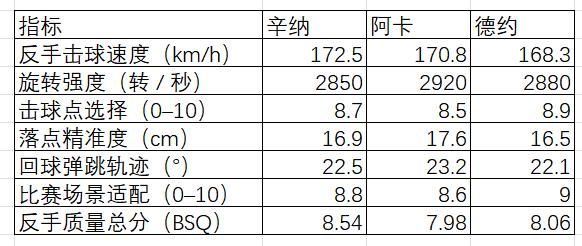
The first category is Backhand Shot Quality (BSQ) indicators. This is the core of backhand metrics, unrelated to backhand scoring outcomes, focusing solely on the technical quality and threat level of the backhand stroke itself. These indicators are calculated based on six core dimensions, tailored to the characteristics of the backhand stroke: backhand stroke speed, spin intensity, contact point choice (rising, peak, descending phase), placement accuracy, ball bounce trajectory, and match context (critical point or regular point). Unlike the forehand, the backhand is divided into one-handed and two-handed backhands. TDI indicators adjust dimension weights accordingly (e.g., two-handed backhands emphasize speed and power, one-handed backhands emphasize spin and placement).
The second category is backhand efficiency indicators. These are "result-oriented" metrics, presented as percentages. Their core function is to see whether backhand quality translates into points or advantages, linking with Backhand Shot Quality (BSQ) indicators to explain "why some players have high backhand quality but low scoring rates."
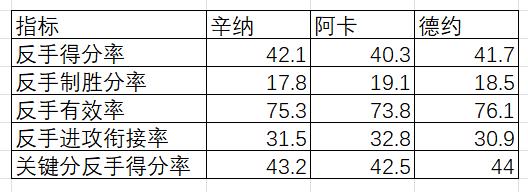
There are five core indicators in this category, listed as follows: (1) Backhand Scoring Rate: The proportion of points won in backhand exchanges, higher values indicate stronger backhand scoring ability; (2) Backhand Winner Rate: The proportion of backhand strokes that directly win the point, reflecting the finishing ability of the backhand; (3) Backhand Effectiveness Rate: The proportion of backhand strokes successfully returned without giving the opponent a direct attacking opportunity, reflecting the stability of the backhand; (4) Backhand Attack Transition Rate: The proportion of backhand strokes followed by immediate initiation of continuous attack and gaining initiative, reflecting the transition ability after the backhand; (5) Critical Point Backhand Scoring Rate: The scoring proportion in backhand exchanges under critical point scenarios, reflecting backhand stability under pressure.
The third category is backhand tactical distribution indicators. They serve as the bridge connecting backhand quality and efficiency, explaining why, with similar backhand quality, some players score more and others less, focusing on players' backhand tactical choices and diversity. The core indicators are three: (1) Backhand Placement Distribution: The proportion of backhand returns landing in different areas of the opponent's court (inside corner, outside corner, midcourt, deep zone), revealing the player's tactical emphasis; (2) Backhand Spin Type Distribution: The proportion of backhand return spin types (topspin, sidespin, flat, slice), more spin variations make it harder for opponents to predict; (3) Backhand Entropy: Measuring the unpredictability of backhand placement and spin, higher entropy indicates more diverse backhand choices, making it harder for opponents to prepare specifically.
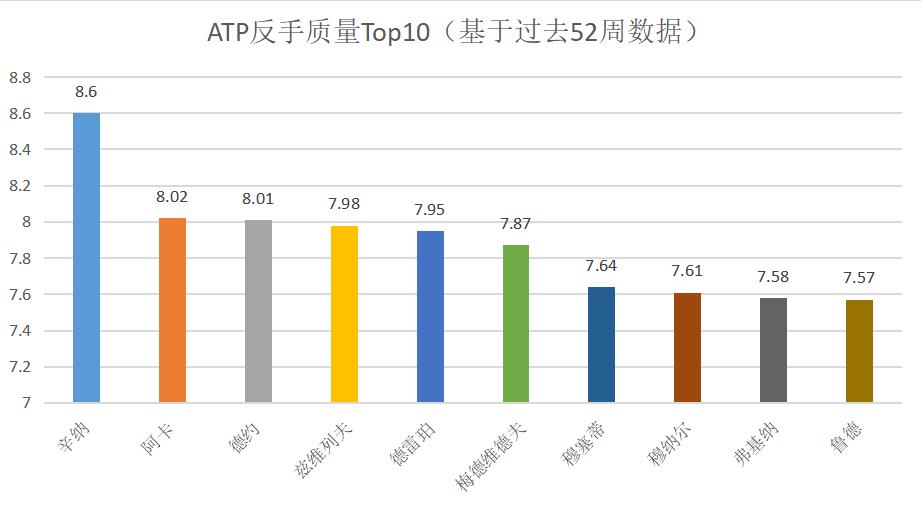
Based on the above three major categories of indicators, ATP lists the Top 10 backhand quality rankings over the past 52 weeks, as shown in the figure below.
3. Comparative analysis of backhand quality indicators for Sinner, Alcaraz, and Djokovic
Combining ATP's publicly available data over the past 52 weeks, we again take Sinner, Djokovic, and Alcaraz as examples to compare their TDI core backhand indicators. This allows us to intuitively understand the function of TDI backhand indicators and clearly see the differences in the three players' backhand styles.
1. Backhand Quality Indicators
2. Backhand Efficiency Indicators
3. Backhand Tactical Distribution Indicators
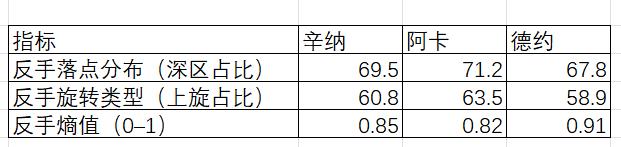
Through the above three major categories of indicators, aided by AI, we can analyze the backhand characteristics of the three players.
(1) Quality Dimension: Sinner has the highest total BSQ score, with balanced speed, spin, and placement, making it his signature weapon; Djokovic excels in contact point, accuracy, and context adaptation, with top-tier stability; Alcaraz stands out in spin and bounce, showing strong aggressive attributes but slightly lower stability.
(2) Efficiency Dimension: Sinner leads in backhand scoring rate, with smooth offense-defense transitions; Djokovic has the highest critical point backhand scoring rate, demonstrating the strongest pressure resistance; Alcaraz has the highest backhand winner rate, highlighting exceptional finishing ability.
(3) Tactical Dimension: Alcaraz has the highest proportion of deep zone and topspin shots, showing the strongest offensive aggression; Djokovic has the highest entropy, with the most tactical variations, making him hard to predict; Sinner has precise placement and spin control, with balanced tactical choices. (Source: Tennis Home, Author: Yun Juan Yun Shu)

 Links
Links
 Contact
Address:UNIT 1804 SOUTH BANK TOWER, 55 UPPER GROUND,LONDON ENGLAND SE1 9E
Number:+85259695367
E-mali:[email protected]
 App
App


