



How does the Vietnam women's volleyball team typically attack, and what technical mistakes do they often make?



When something repeats too often, it's usually not good. If the attack patterns become too familiar, opponents can easily read them. Repeated mistakes hinder performance improvement. Unfortunately, the Vietnam women's volleyball team is currently in this situation.
Lack of diverse attack patterns
We are playing with insufficient variation. The reason for this situation is the limitations in setting and the players' movement and tactical positioning abilities.
Vietnamese setters often set slowly, with inconsistent pass quality, very limited ability to handle poor passes, lack of flexibility in distributing the ball, and weak jump-setting skills.
They usually set only to the two wings for the outside hitter or opposite, or to the middle blocker. The slow setting speed and predictable ball destinations make it easy for opponents to anticipate.
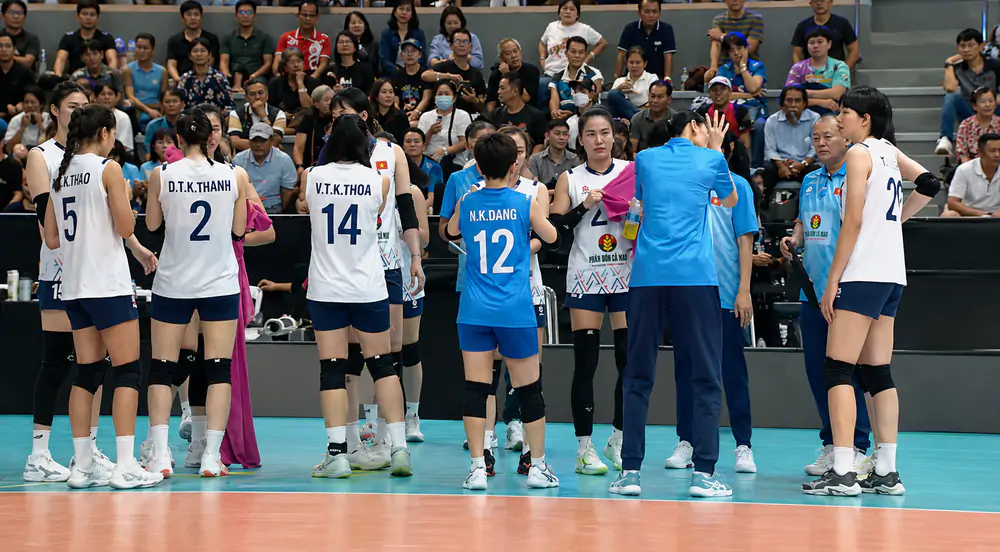
The Vietnam women's volleyball team lacks diverse attacks
However, the team's limited attack variety is not only due to the setters' shortcomings but also because the coach cannot develop many attack options and ensure the players practice these patterns thoroughly until they are fluent.
We are lacking back-row attacks (3x3), back-row spikes, and quick attacks in the middle. The players hardly (or cannot) execute tactical movements to deceive opponents, so the offensive setups lack surprise, as the attack positions and attackers are easily read by opponents who set up blocks in advance.
The team's ability to adapt and adjust its attacking style between sets and after each match is very limited, making it difficult to surprise opponents.
Look at how the Thai team operates. They are a professional model for us to observe and learn from. Overall, their players are not taller than Vietnamese players, but they surpass us not only in strength and endurance but also in competitive mentality, variety of patterns, fluency, and attack speed.
The losses to Thailand should be recorded and carefully analyzed so we can review in detail our mistakes and how the opponents attacked. We need to learn from these consecutive defeats. Is it that difficult to do, or have we never done it seriously?
Weak mentality and lack of progress in serve receiving (first pass)
The weakness in serve receiving is a chronic problem for Vietnamese volleyball over the past few decades, with no signs of improvement.
Occasionally, we have matches where the serve receiving is quite stable, but that is rare. Our players frequently make this error.
Notably, before almost every tournament, the Vietnam women's volleyball team has considerable time for specialized training, yet the players still show no improvement in serve receiving. This forces one to question how the coaching staff has been training them, given that their serve receiving remains poor.

The weakness in serve receiving is a chronic problem for Vietnamese volleyball over the past few decades, with no signs of improvement. Photo: SAVA
This is not a story of just a few tournaments or even a few years; this issue has existed for at least two decades, through many generations of coaches.
It is not without reason that many believe if local coaches cannot help players improve their serve receiving, the Vietnam Volleyball Federation (VFV) must hire a foreign coach for the national women's team to fundamentally solve one of the long-standing problems of Vietnamese volleyball.
If the issue is that VFV lacks funds to hire a foreign coach or is still unwilling to do so, then fans can only sigh.
In addition to the inherent weakness in serve receiving, our players are easily affected mentally, and once that happens, they tend to collapse and become disorganized from defense to offense. We also lack a coach capable of providing psychological support to the female players.

 Links
Links
 Contact
 App
App


